
Corpus of Rococo Commodes
Comparative Furniture and Attribution Research
We have encountered very few commodes comparable to our pair on the art market. Apart from a first example formerly in our collection in 2017, we found another sold at public auction in Monaco in 2015. A third example, which we know only through an eyewitness account, was reportedly offered on the Paris antiques market during the 1980s.
The reunion of our two commodes is therefore an exceptionally rare occurrence and may well be unique.
A Rococo commode formerly in our collection.
Finished in mecca varnish and gilding, with a lacquered faux Rouge de Vérone marble top.
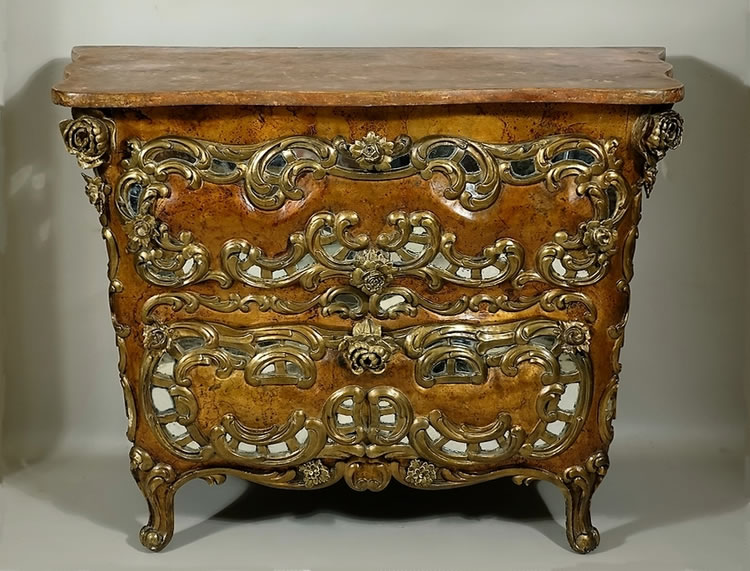
Antiquités Philippe Glédel — archival photograph
At the time, we hesitated considerably over its geographical origin. Italy seemed a natural possibility, particularly because of its mecca varnish. Furthermore, its former owner told us that he had seen a similar commode in a Parisian antiques shop during the 1980s, where the dealer had described it as Italian.
Yet the extraordinarily vigorous Rococo character of the piece also suggested Germany, and more particularly the Bamberg region.
Mecca varnish is an Italian decorative technique. A colored varnish, traditionally based on alcohol and shellac, is applied over a metallic surface, often silver leaf as in this case, protecting it while giving it a warm, golden or vermeil-like brilliance.
Searching through our auction archives, we discovered only one other closely related commode, sold in Monaco in 2015. It appeared to have been relacquered, probably over an earlier mecca finish.
A comparable commode offered at auction in Monte-Carlo.
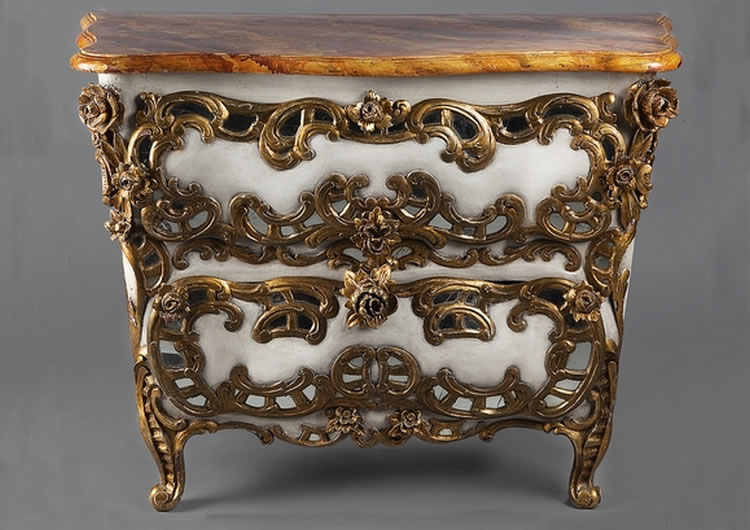
The auction specialist attributed this commode to Russia and dated it to the mid-18th century.
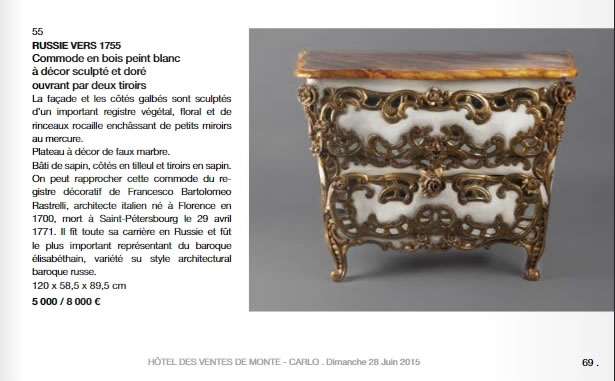
Somewhat puzzled, we telephoned the specialist, Stéphane Pèpe, and asked him directly whether the Russian attribution might have been influenced by the substantial Russian clientele then present on the French Riviera.
He readily acknowledged that, since Baroque decorative forms had spread throughout Europe, a German origin was also possible, or indeed an Italian one.
Shortly afterwards, a colleague who had seen our commode visited TEFAF Maastricht. There he encountered a commode of similar dimensions that reminded him strongly of ours and sent us the following photograph.
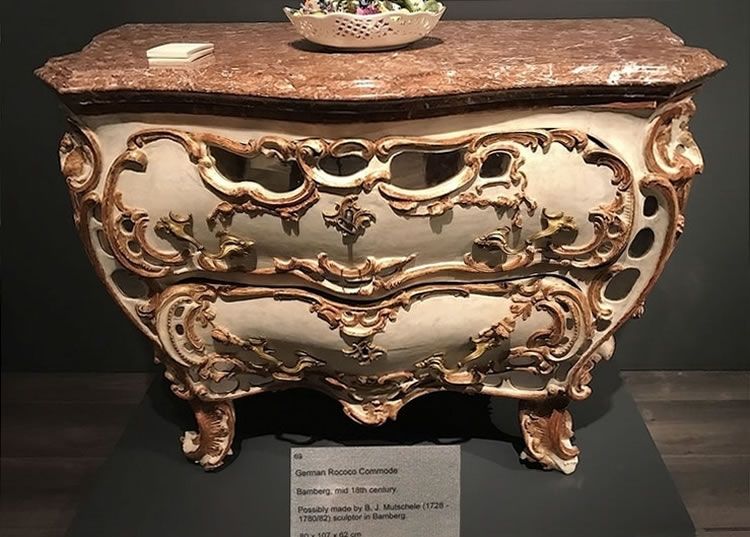
Documentary photograph taken at TEFAF Maastricht
This commode, offered at TEFAF for €60,000, seemed to confirm a German origin, perhaps even Bamberg. Mirrors set within elaborate carved surrounds were, after all, a highly unusual feature. We had never previously encountered them on a commode and had scarcely imagined such a decorative arrangement.
We therefore adopted the attribution to Bamberg.
The curious sequel was that we subsequently sold our commode, through a major Dutch antiques dealer, to a distinguished Rhineland specialist in German Baroque furniture. He initially informed us that Bamberg was not the correct origin and that nearby Würzburg was considerably more likely.
Only several years later did he finally conclude that the commode was Italian.
Following the acquisition of our present two commodes, we resumed the investigation in greater depth.
One of them bore the branded inventory mark of one of Europe's most distinguished families. Yet even this evidence did not immediately resolve the question of origin: did the mark refer to the German Thurn und Taxis family or, more probably, to its Italian branch, the della Torre e Tasso?
The second commode had been purchased from a property in the South of France. When questioned about its history, our seller readily explained that he had acquired it at the Antibes antiques fair from the internationally renowned dealer Jean Gismondi, with whom he maintained a friendship.
Gismondi had assured him that the commode's previous owner was the Italian actor Marcello Mastroianni. Anyone familiar with the personalities of Mastroianni and Gismondi would hardly find their meeting surprising; indeed, it might be more surprising if it had not led to a friendship.
We also contacted the former owner of our first commode, a longstanding friend whose family had inherited it over several generations. We asked him once again about the similar example he had seen in Paris during the 1980s.
He then recalled that it had been offered by the antiques dealer Jean Sarfati, on the rue de Beaune. This was a significant detail that we should not have overlooked during our earlier research, since Sarfati was a respected specialist in Italian furniture.
According to our friend's recollection, Sarfati had insisted upon the commode's Italian origin and its 18th-century date, despite the doubts expressed by many visitors, including professionals.
Sarfati explained that the construction could be deceptive: the cabinet carcasses were sometimes deliberately simple, the emphasis being placed on the decorative exterior. He also observed that earlier examples could have wooden tops, before marble tops became customary.
Most importantly, he believed the commode came from Sicily.
The Five Commodes Identified in Our Research
First commode: Formerly offered by the Paris antiques dealer Jean Sarfati. Unfortunately, this example remains undocumented.
Second commode: Formerly at the Château de Penhoët in Grandchamps, a property later associated with Karl Lagerfeld. The commode subsequently passed through marriage and remained within the Jobbé-Duval family, a distinguished Breton family of painters, artists and decorators, before entering our collection.
Third commode: Sold at the Hôtel des Ventes de Monte-Carlo in 2015.
Fourth commode: Formerly in the Thurn und Taxis collection or, more probably, that of the Italian della Torre e Tasso branch. If the latter attribution is correct, an origin at Duino Castle is a strong possibility.
The commode subsequently belonged to the collection of the Château de Wannegem-Lede, also known as the Château de Ghellinck d'Elseghem, celebrated as the “Château of Châteaux” or the “Little Trianon of Flanders,” before entering our collection.
Fifth commode: Formerly in the collection of Jean Gismondi, followed by a private collection in a villa at Mougins, in the South of France, before entering our collection.
And, of course, there is the additional and particularly evocative provenance of Marcello Mastroianni, one of the greatest actors of cinema's golden age.
Famous for the image of the “Latin lover,” a label he personally disliked, Mastroianni inspired our seller to remark, with a certain mischievousness: “If my commode could speak, it would have quite a few stories to tell!”

Documentation and Comparative Furniture
Baroque art emerged in Italy during the 17th century and developed with particular brilliance in Turin, Naples, Sicily and Venice.
The French rocaille, a decorative development of the Baroque tradition, emerged during the Régence and flourished under Louis XV. Charles Cressent, Gilles-Marie Oppenordt and Juste-Aurèle Meissonnier were among the important figures associated with its development.
François de Cuvilliés played a major role in introducing and developing Rococo decoration in Bavaria.
Baroque and Rococo forms spread throughout Europe, finding particularly exuberant expression in the German-speaking territories of the Holy Roman Empire. The decorative language also reached Russia, notably through the work of Bartolomeo Rastrelli.
In southern Germany, important centers included Munich, Würzburg, Bamberg and Bayreuth. Among the craftsmen associated with these traditions were Johann Adam Pichler, Johann Melchior Kambli, Johann Christian Hoppenhaupt, Franz-Martin Mutschele, Nicolaus Bauer and the Spindler brothers.
The Amalienburg pavilion at Nymphenburg Palace offers an outstanding example of Bavarian Rococo. Much later, King Ludwig II revived the style on a spectacular scale at Linderhof Palace.
These artistic exchanges also extended through Bohemia and Hungary and contributed to the development of exuberant decorative furniture in Italy, notably in Venice, Turin, Naples and Sicily.
In Venice, Andrea Brustolon and the tradition of lacquered furniture deserve particular attention. In Turin, Pietro Piffetti and Giuseppe Maria Bonzanigo represent other important aspects of Italian decorative craftsmanship.
The following examples illustrate the wider European context in which our Sicilian commodes may be studied.

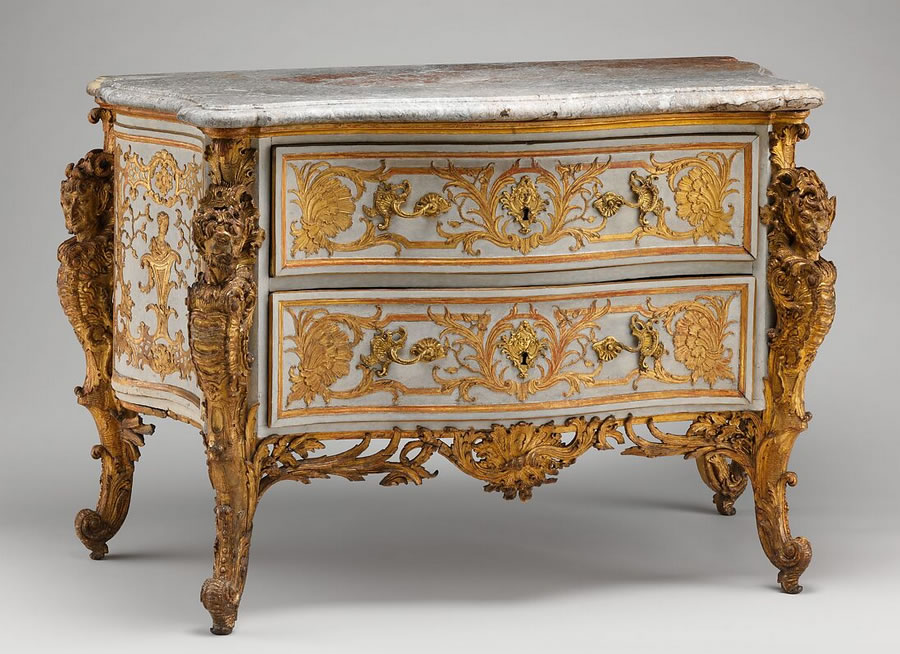
Documentation concerning a Rococo commode from Seehof Palace.

An Important Pair of Neo-Rococo Commodes from Linderhof Palace
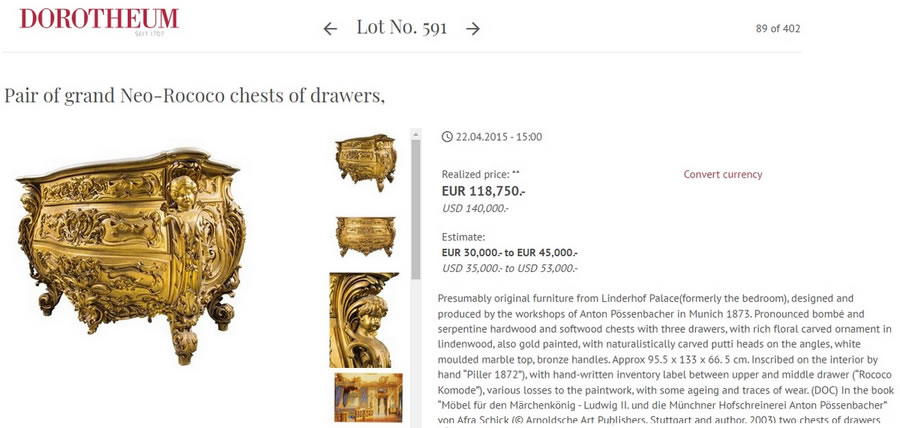
These commodes were described in the German catalogue as probably original furnishings from Linderhof Palace, formerly installed in a bedroom, designed and produced by the Munich workshops of Anton Pössenbacher in 1873.
They are three-drawer commodes made of hardwood and softwood, with strongly curved and serpentine outlines. Their elaborate carved floral ornament, gilded decoration and naturalistically sculpted putti heads at the corners are characteristic of the exuberant Neo-Rococo taste favored by Ludwig II of Bavaria.
They have molded white marble tops and bronze handles.
Dimensions: approximately 95.5 × 133 × 66.5 cm.
The catalogue records the handwritten inscription “Piller 1872” inside, together with an inventory label reading “Rococo Komode” between the upper and middle drawers. It also mentions losses to the painted decoration and other signs of age and wear.
Adapted from the German catalogue description.

Antiquitäten Metz GmbH — Rococo Commode
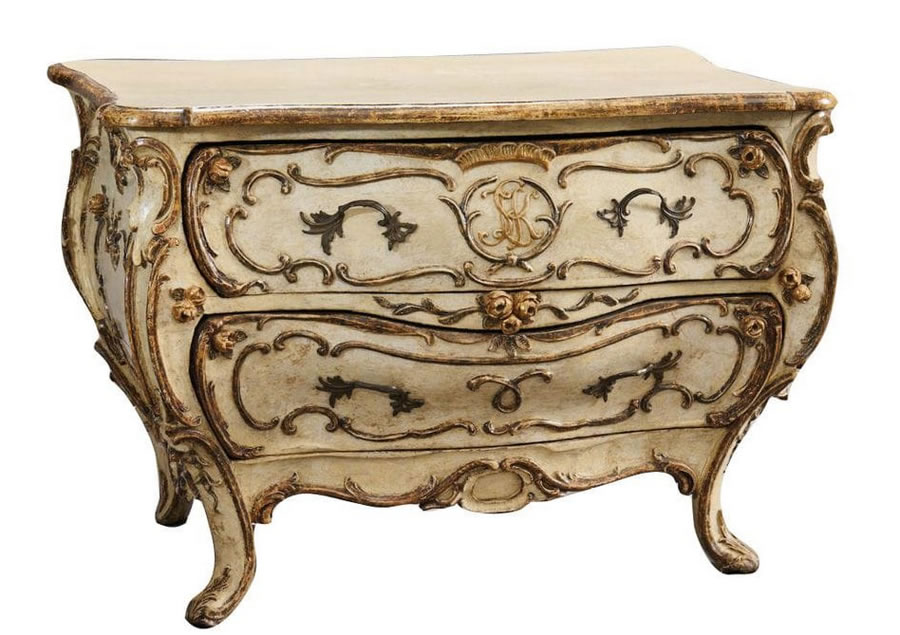
A Rediscovered Masterpiece of Franconian Rococo.
The German catalogue describes an exceptionally rare Rococo commode from Upper Franconia, Bamberg, dating to approximately 1755–1760.
Dimensions: height 76 cm, width 107 cm, depth 66 cm.
The design is tentatively associated with Ferdinand Hundt (1703–1758). The commode bears a ligatured alliance monogram, “JS & CL,” beneath a count's coronet.
Made of carved softwood, it has a slate-white painted ground enriched with gold and silver decoration. Its molded top curves on three sides, while the two-drawer body displays virtuoso serpentine movement above a shaped apron and outward-curving legs.
Elaborate S- and C-scrolls frame the side panels. Carved roses, petals and foliage enrich the surfaces, while three roses appear beneath the alliance monogram on the central front rail.
The catalogue proposes a provenance from the Franconian nobility, possibly the von Seinsheim family, followed by Kunsthandel Fischer-Böhler, Munich, during the 1950s, and subsequently a private collection.
The commode belongs to a small and particularly rare group of slate-white painted furniture produced around Bamberg between approximately 1755 and 1765.
An important comparison is the celebrated so-called “night commode” from Seehof Palace, now in the Metropolitan Museum of Art, New York, accession number 1974.356.129.
The art historian Sigrid Sangl illustrated the commode in her study of Bamberg court cabinetmaking alongside the Metropolitan Museum example.
The two pieces share an organic conception of form, with powerful scrollwork surrounding and animating the surfaces. Related decorative features appear in the interiors of Seehof Palace.
The catalogue places these developments within the furnishing campaigns associated with the prince-bishops Johann Philipp Anton von und zu Frankenstein and Adam Friedrich von Seinsheim.
It also recalls the dispersal of the furnishings of Seehof Palace from approximately 1955 onwards through the Munich art dealer Karl Fischer-Böhler.
Much of this remarkable Franconian ensemble, which had survived the Second World War largely intact, was sold to an international clientele, particularly in the United States.
These dispersals, which included commodes, consoles, benches, mirrors, decorative sculpture and other furnishings, provoked considerable criticism among art historians, notably Heinrich Kreisel.
English presentation based on the German catalogue notice reproduced in the French documentation.
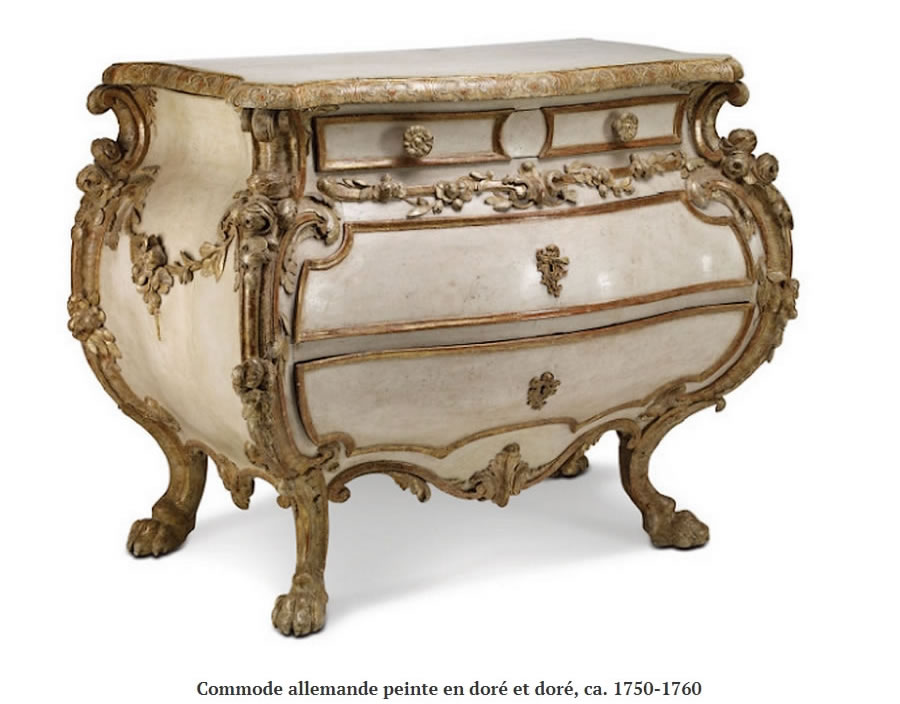
Rococo Commode Exhibited at the San Francisco Fall Antiques Show, 2010
Rococo Commode at the Metropolitan Museum of Art, New York
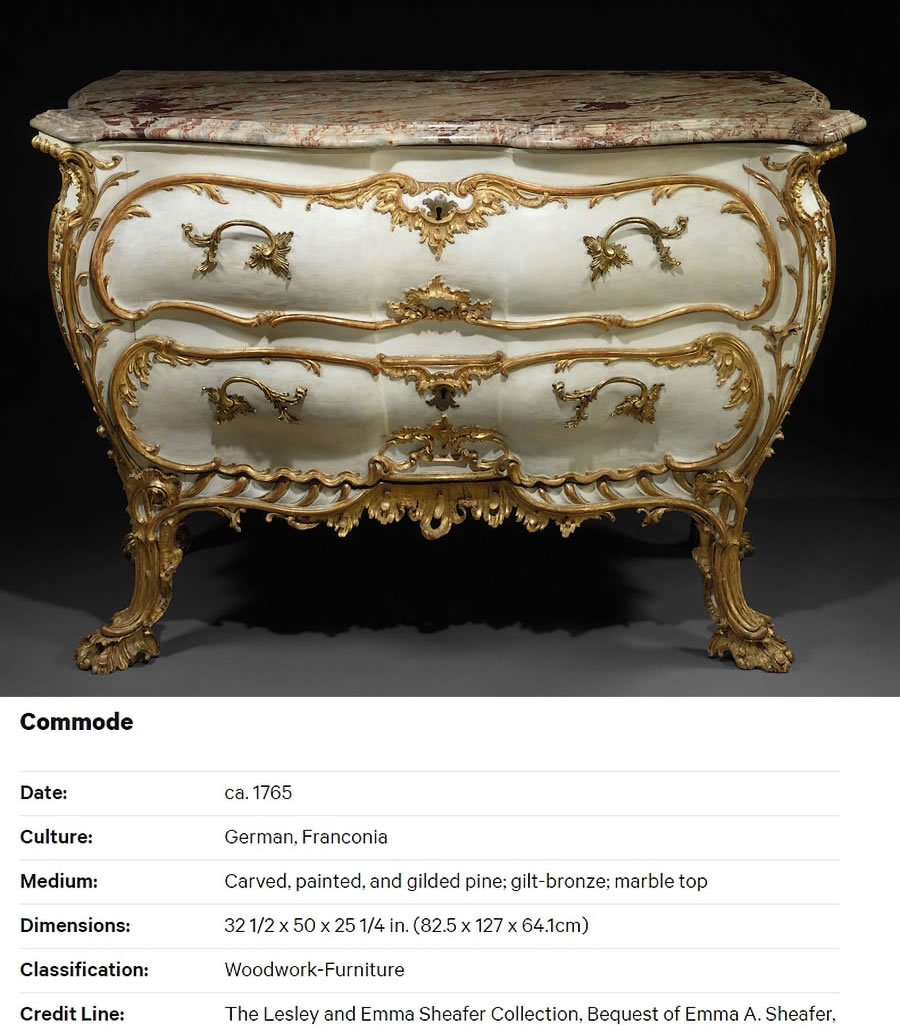
Le meuble français et européen du Moyen Âge à nos jours
Pierre Kjellberg
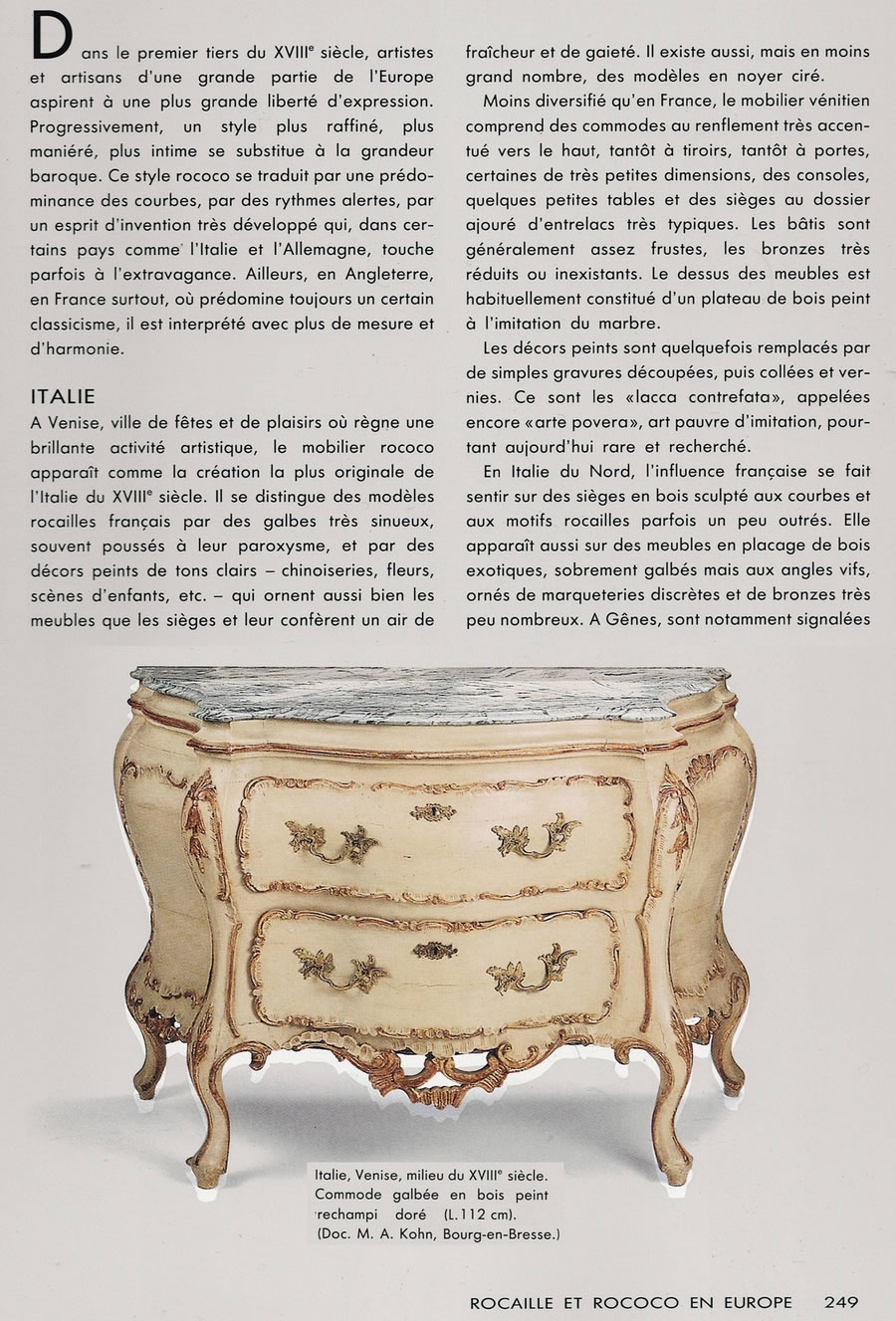
Le mobilier italien du XVIIIe siècle
Giacomo Wannenes
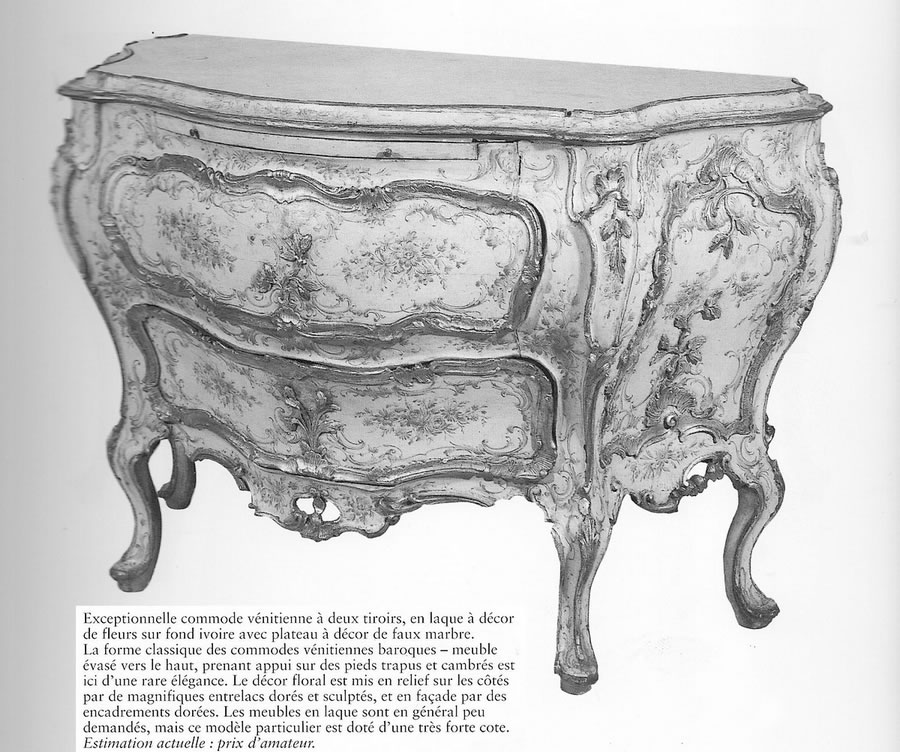
Rococo Furniture from Naples and Sicily
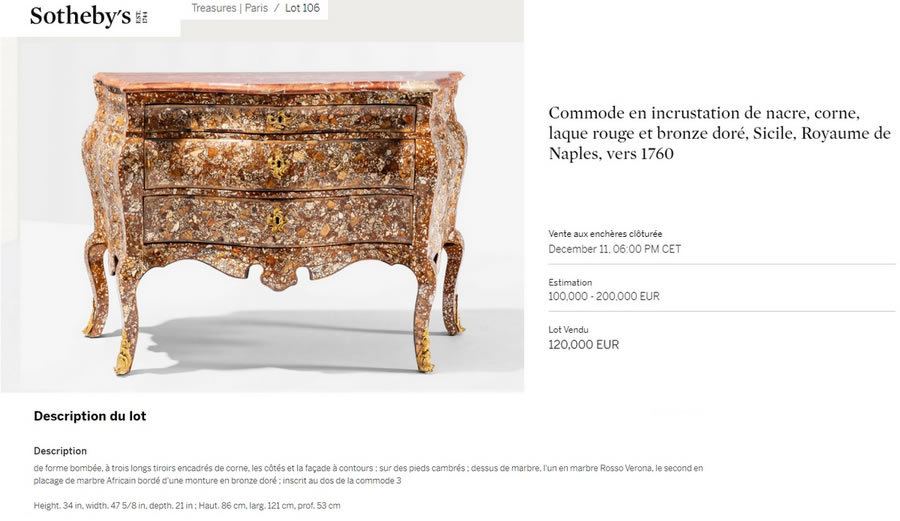
Naples and Sicily produced other Rococo commodes of extraordinary decorative daring. The following example, decorated with lacquer, mother-of-pearl and horn inlay beneath a Rouge de Vérone marble top, provides a particularly striking comparison.
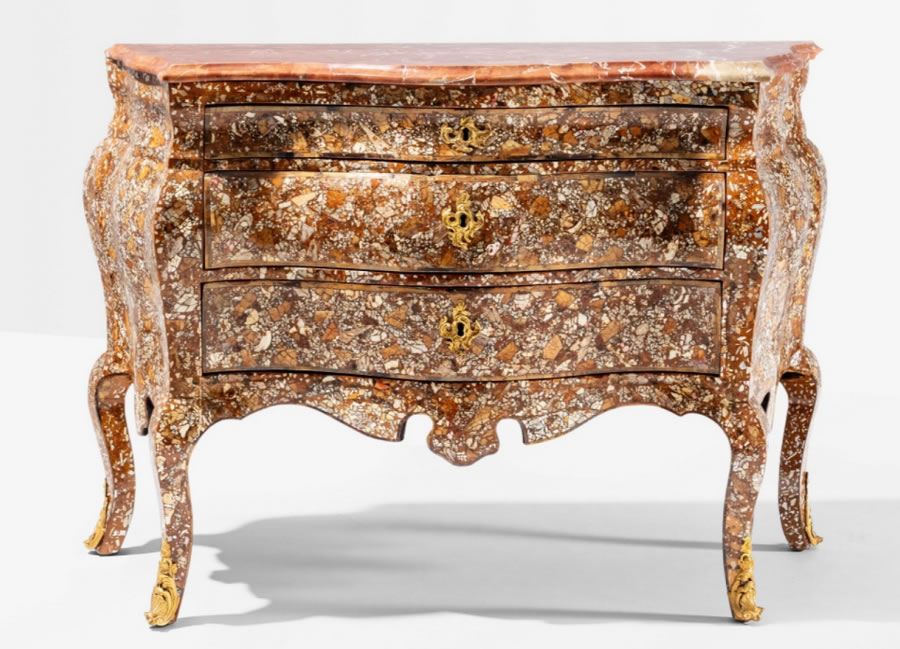
An Italian Baroque Commode Sold in Rome
Another remarkable commode from an Italian collection was sold in Rome on March 14 for €37,000, including fees, confirming the continuing appeal of the most extravagant Baroque and Rococo furniture.
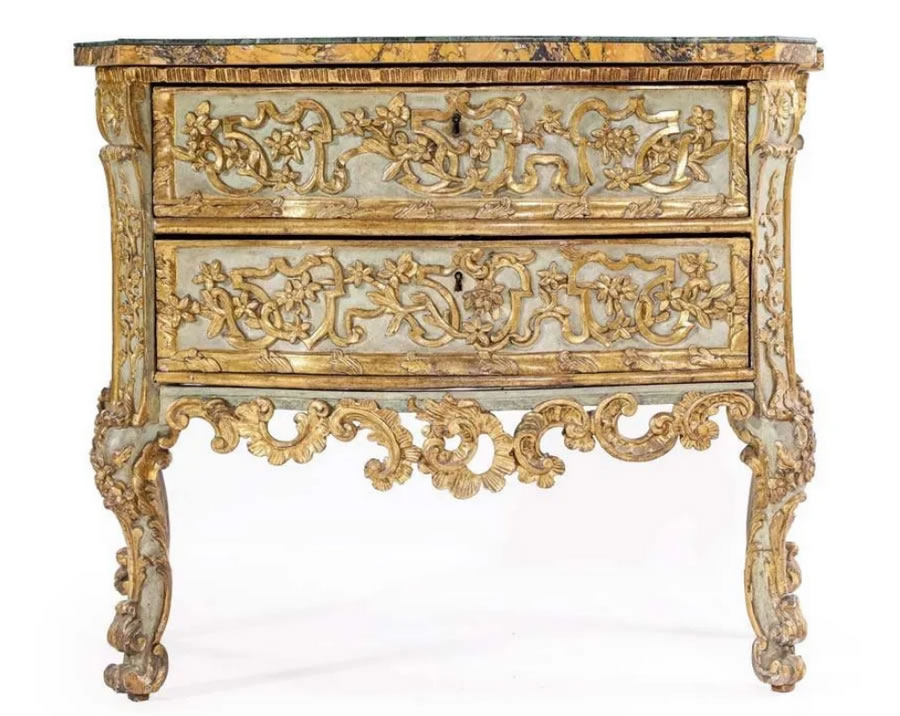
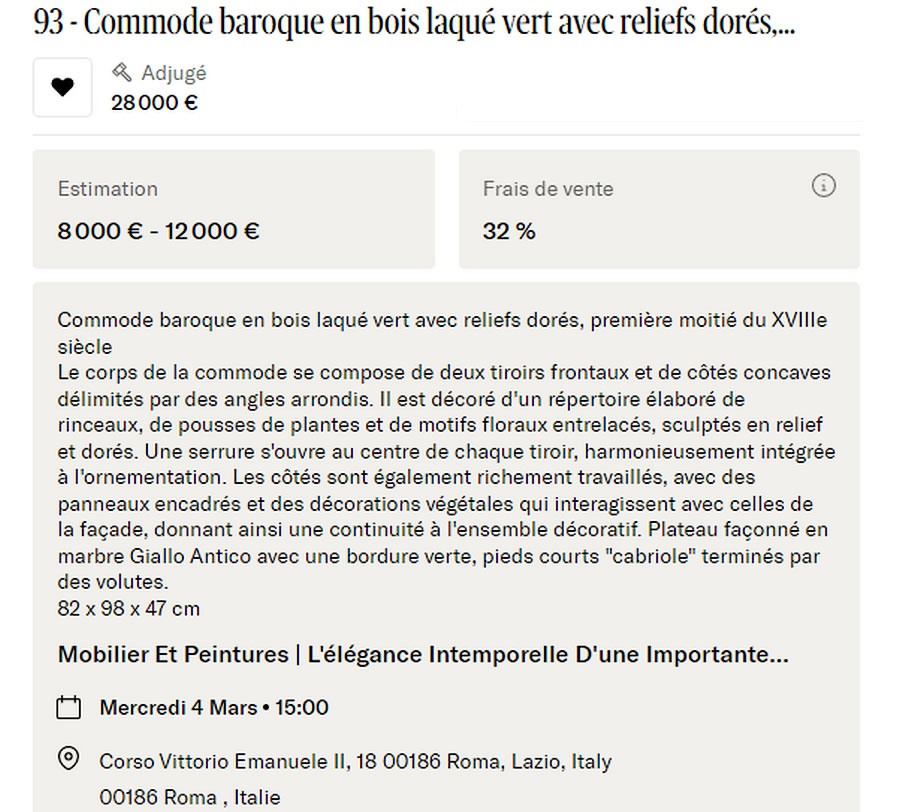
Pair of Sicilian Rococo Commodes
“With a Hundred Mirrors”
Return to the complete presentation of the exceptional pair of Sicilian Rococo commodes, including their description, photographs, condition and distinguished provenances.
RETURN TO THE SICILIAN COMMODES