Philippe Glédel Antiques

Pair of Sicilian Rococo Commodes “with a Hundred Mirrors”

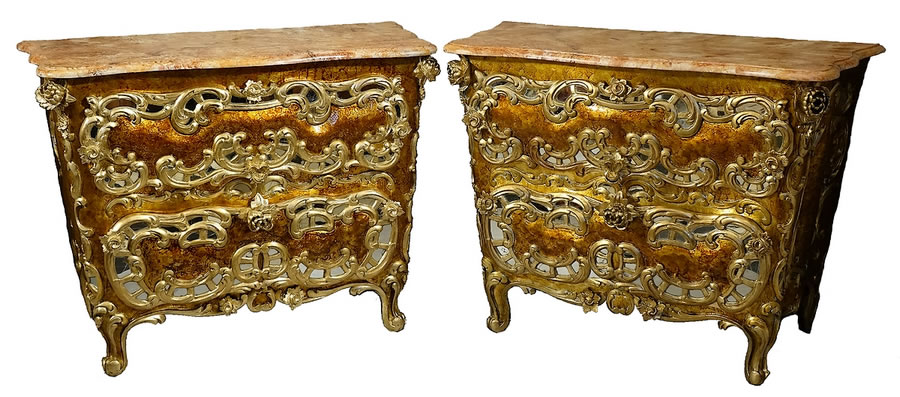
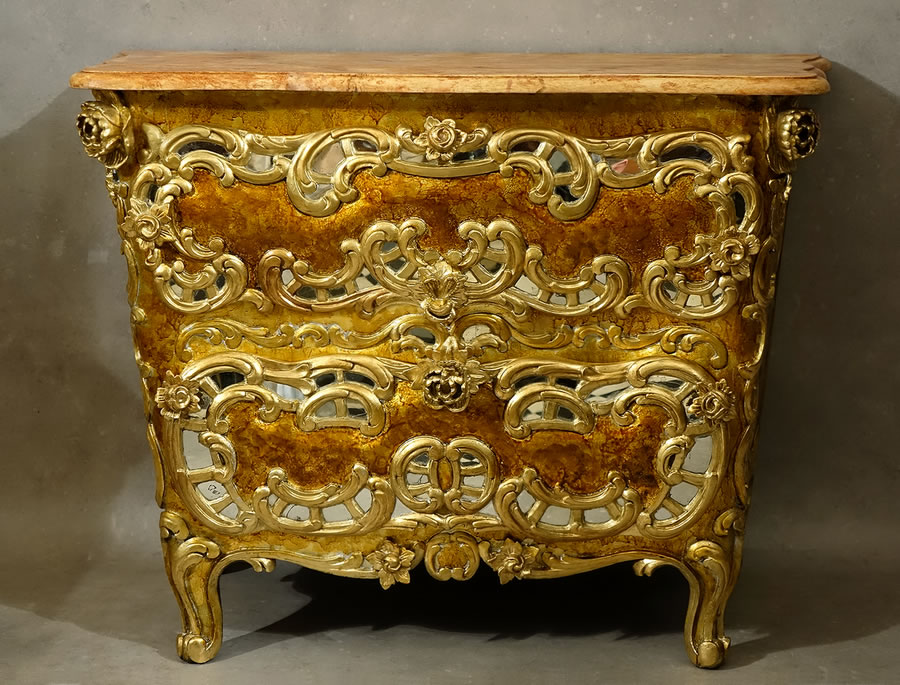
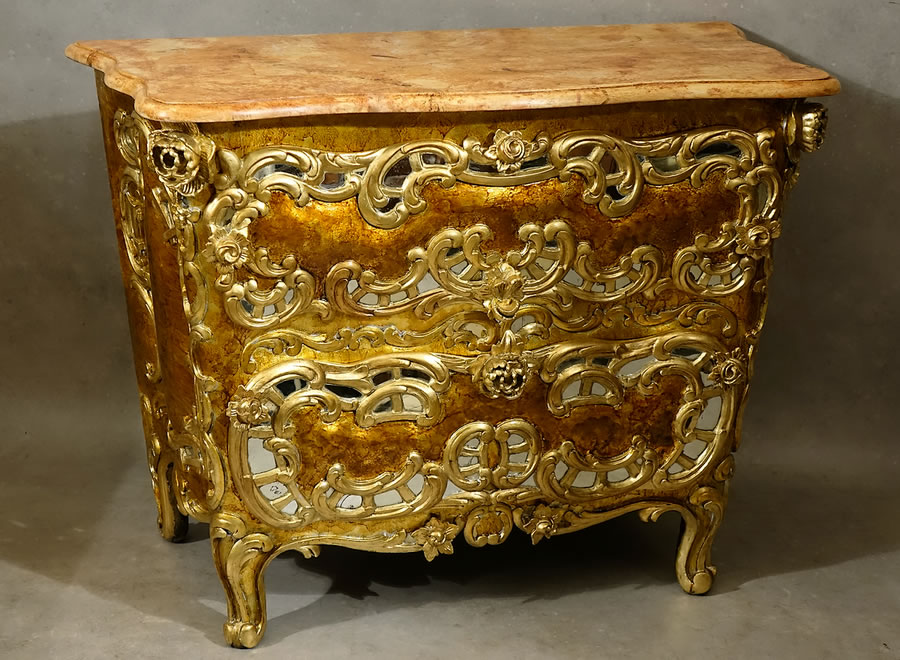
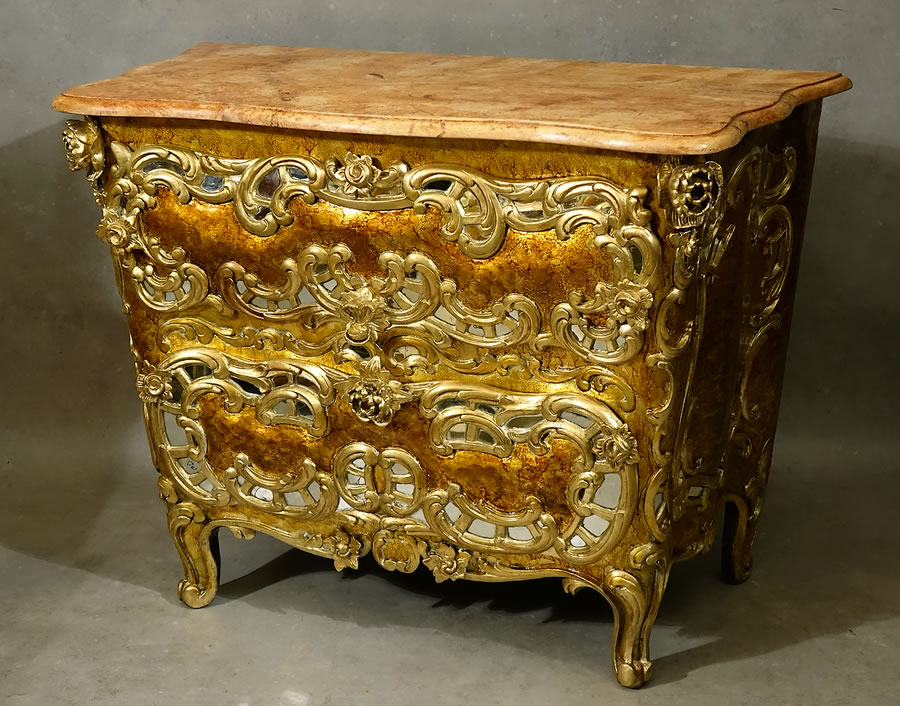
Pair of Sicilian Rococo commodes, carved, gilded and finished in mecca varnish

Exceptional pair of Italian commodes in carved and lacquered wood,
gilded and finished in “mecca” varnish. One formerly in the della Torre e Tasso collection,
the other formerly in the Marcello Mastroianni collection.


An Exceptional Pair of Sicilian Rococo Commodes

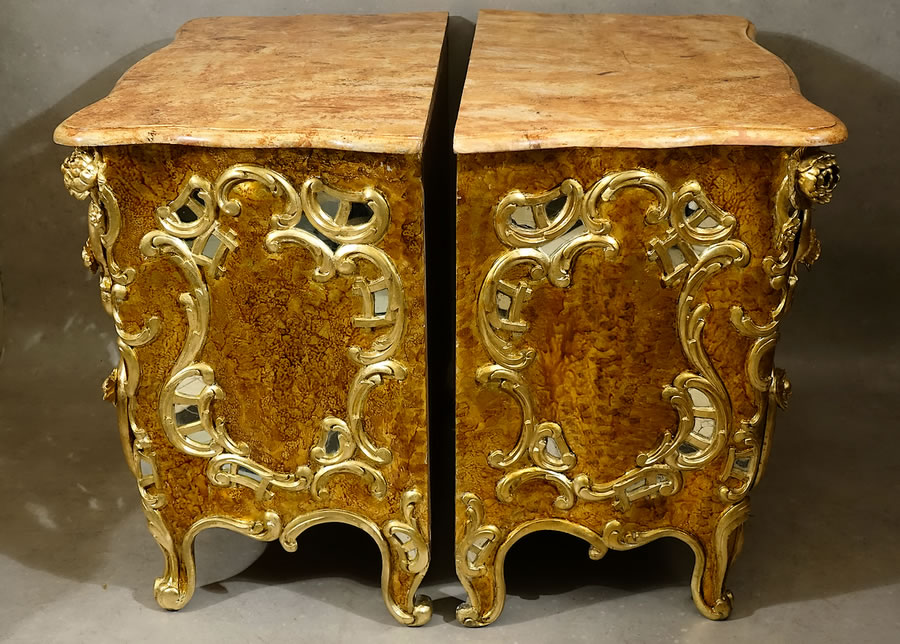
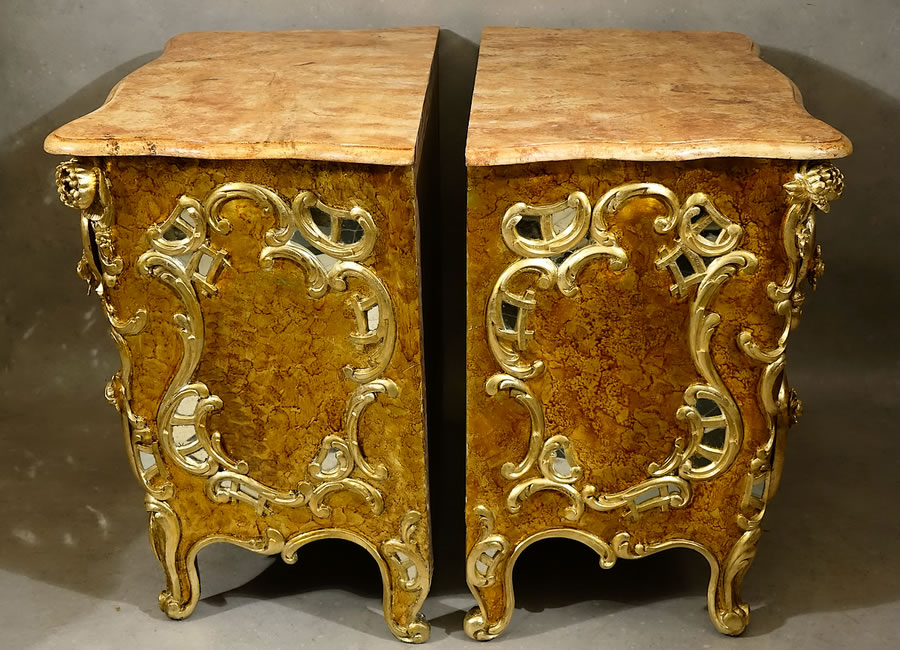
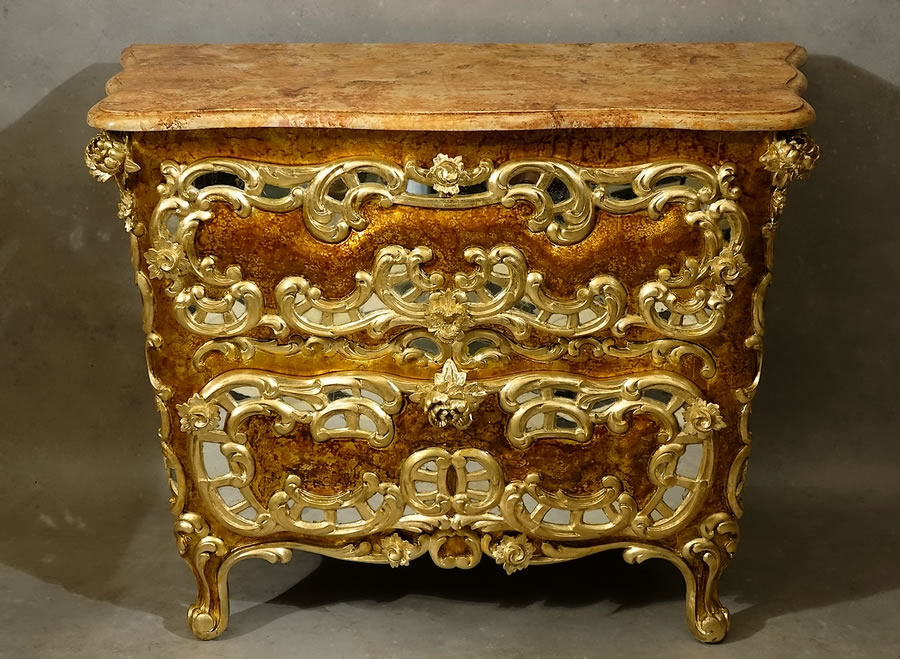
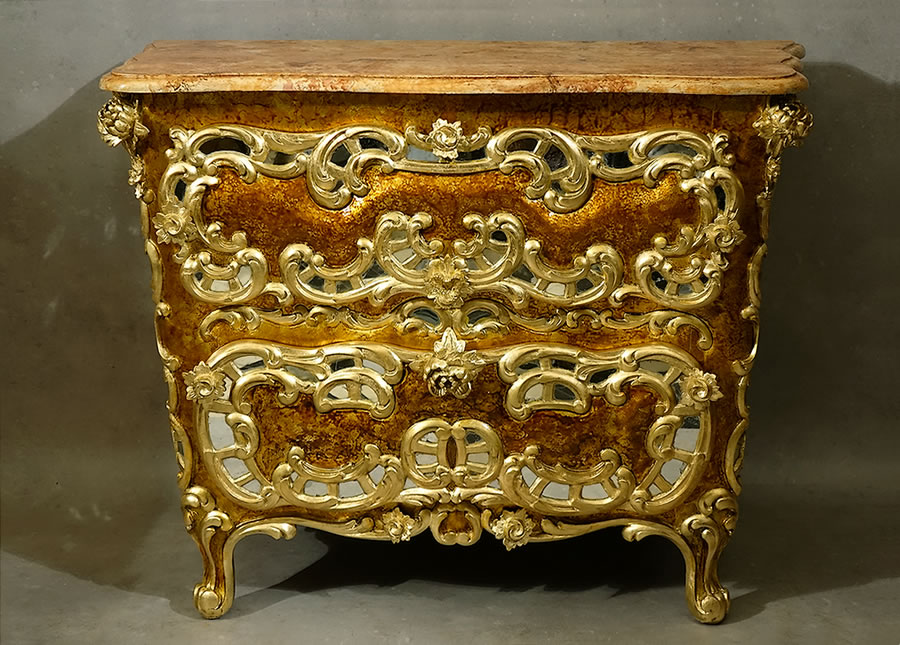
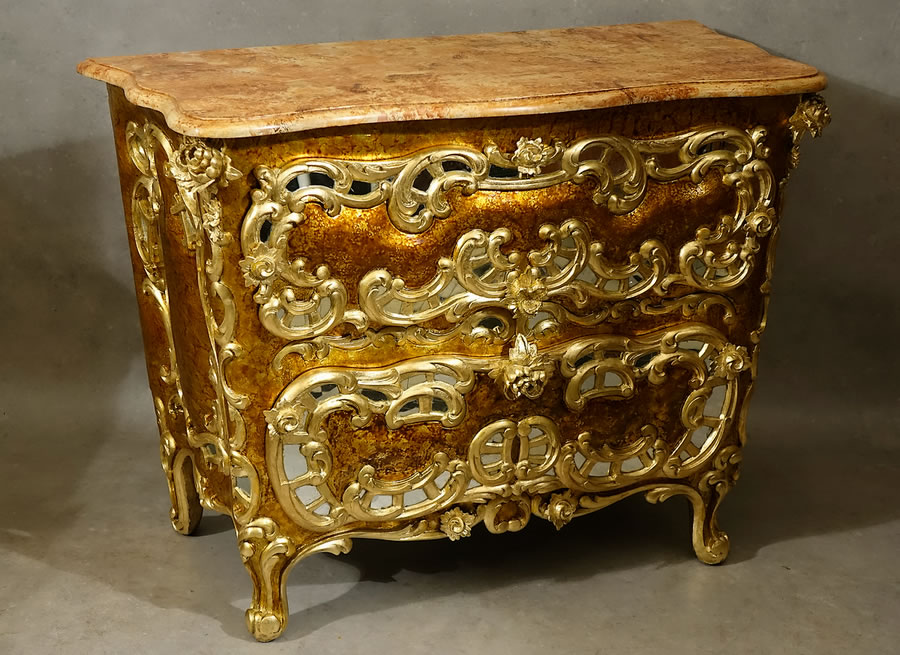
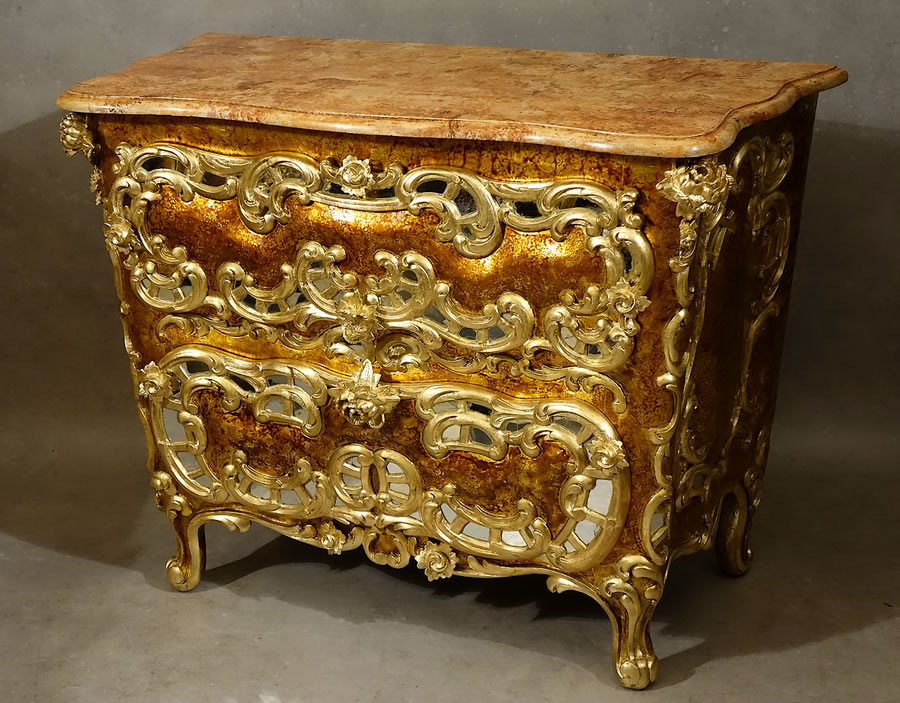
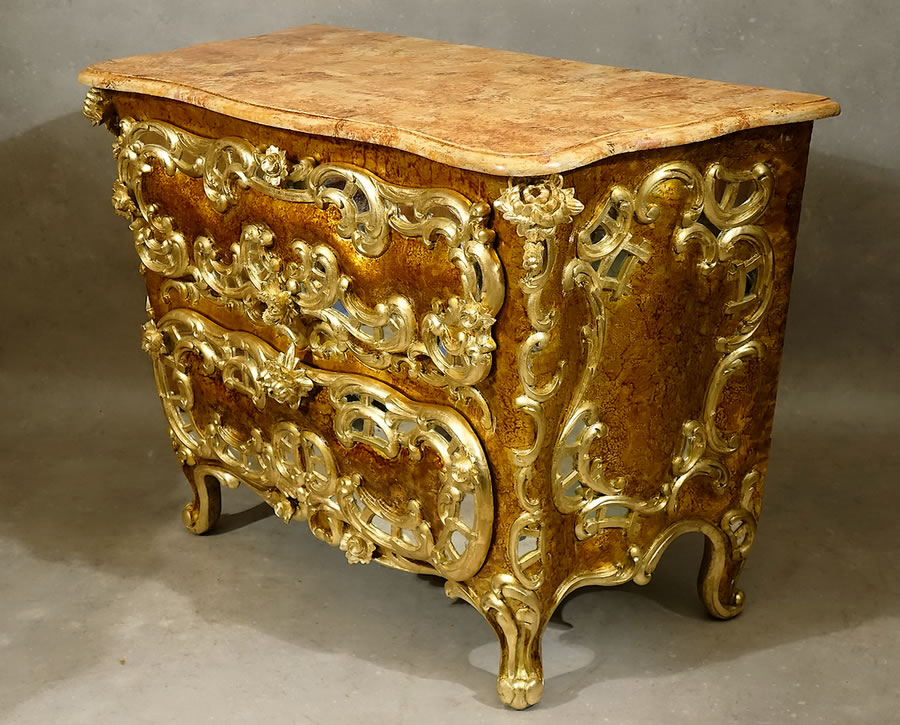
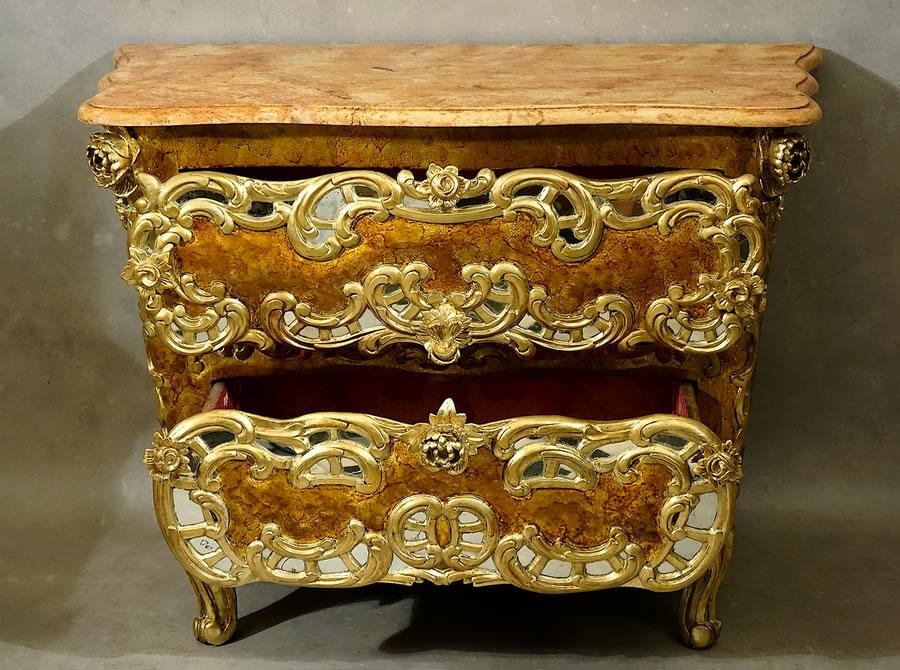
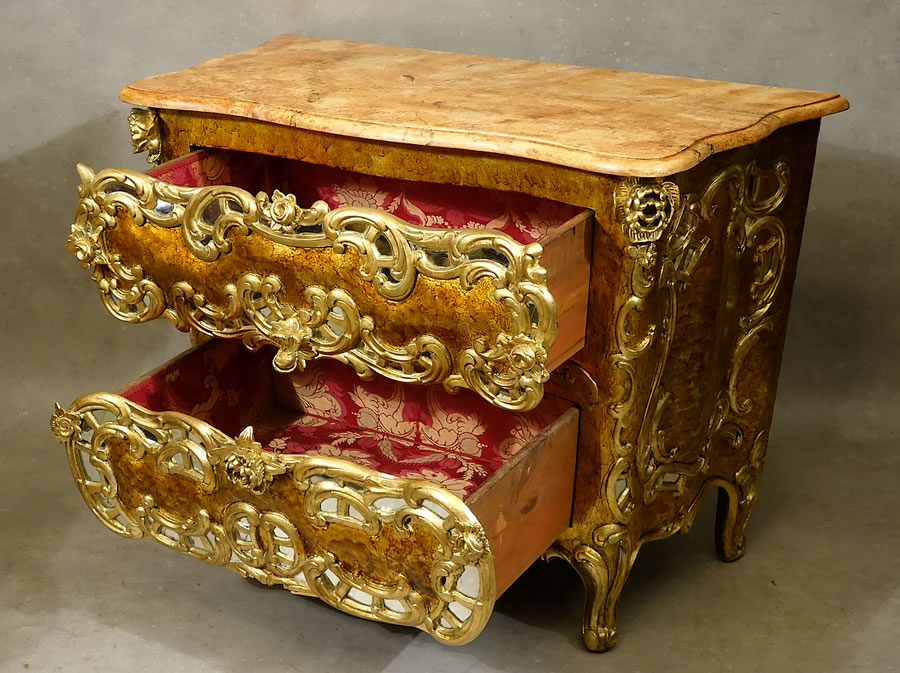
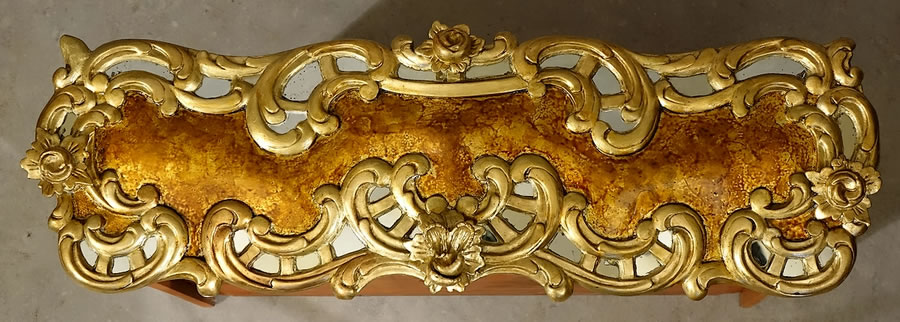
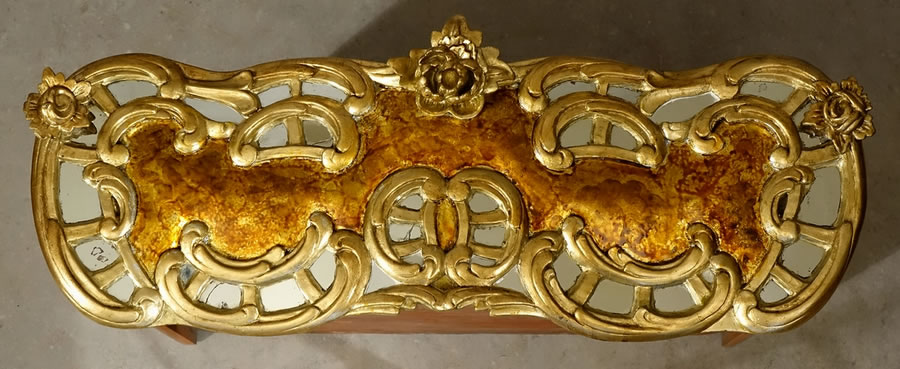
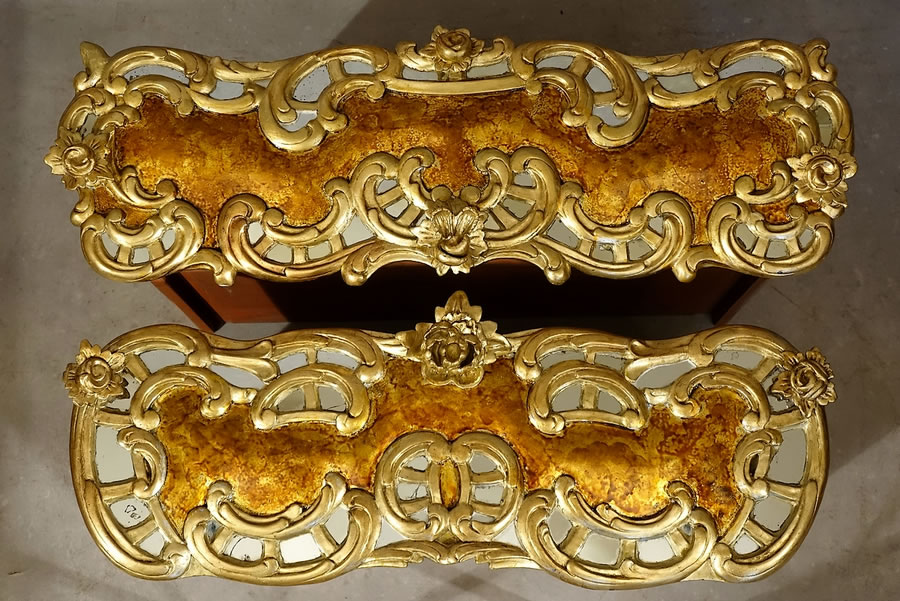
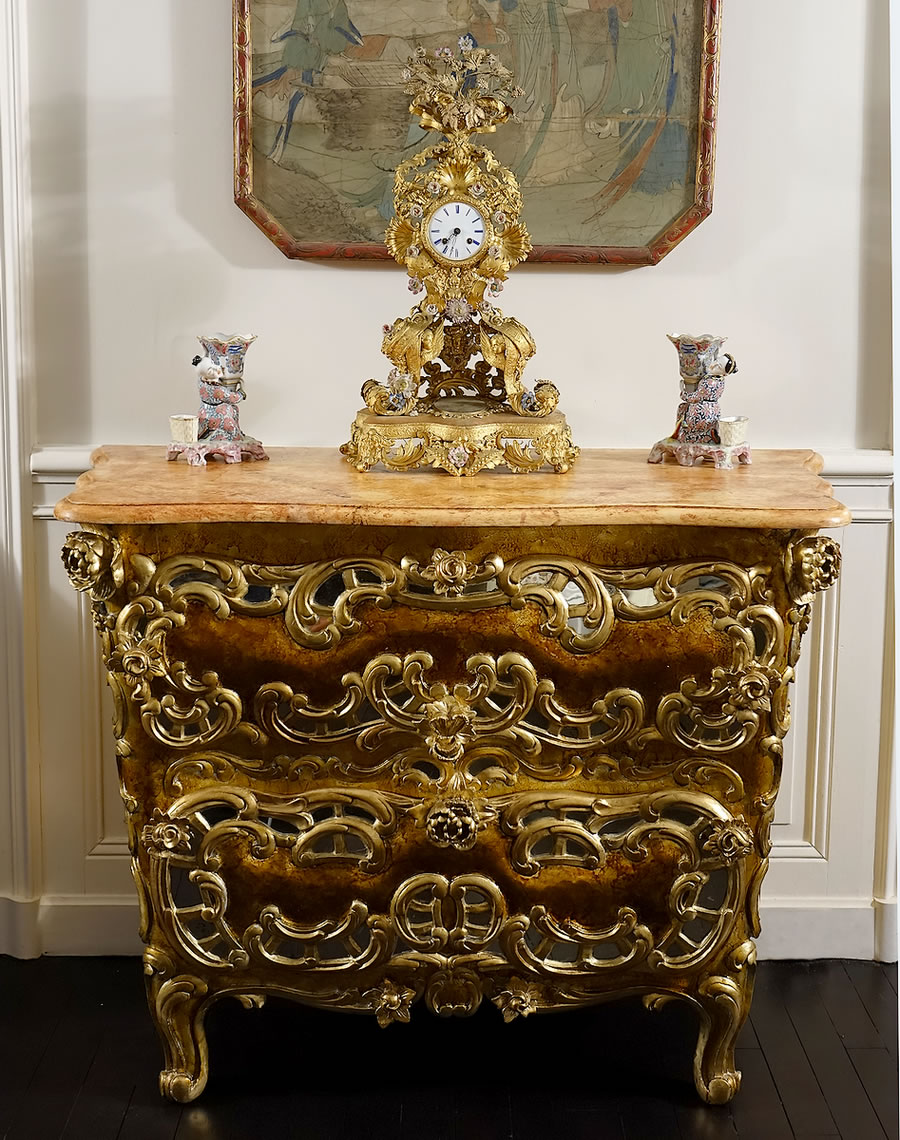
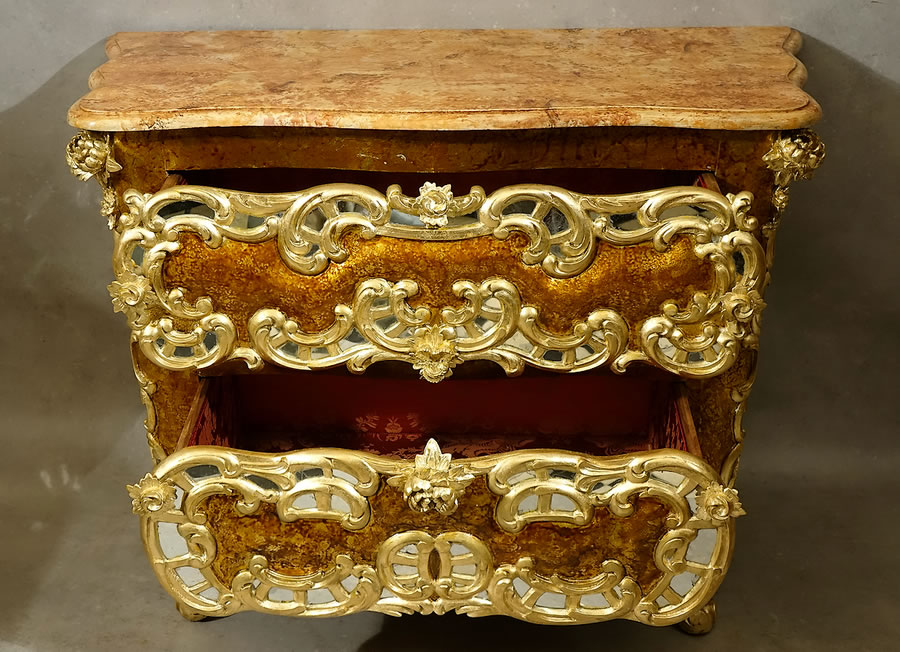
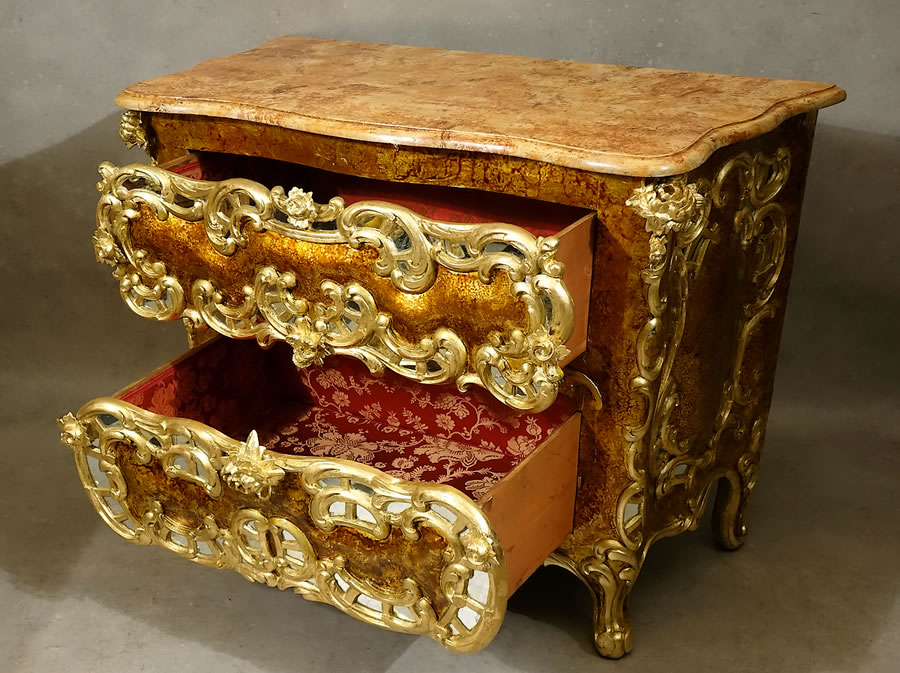
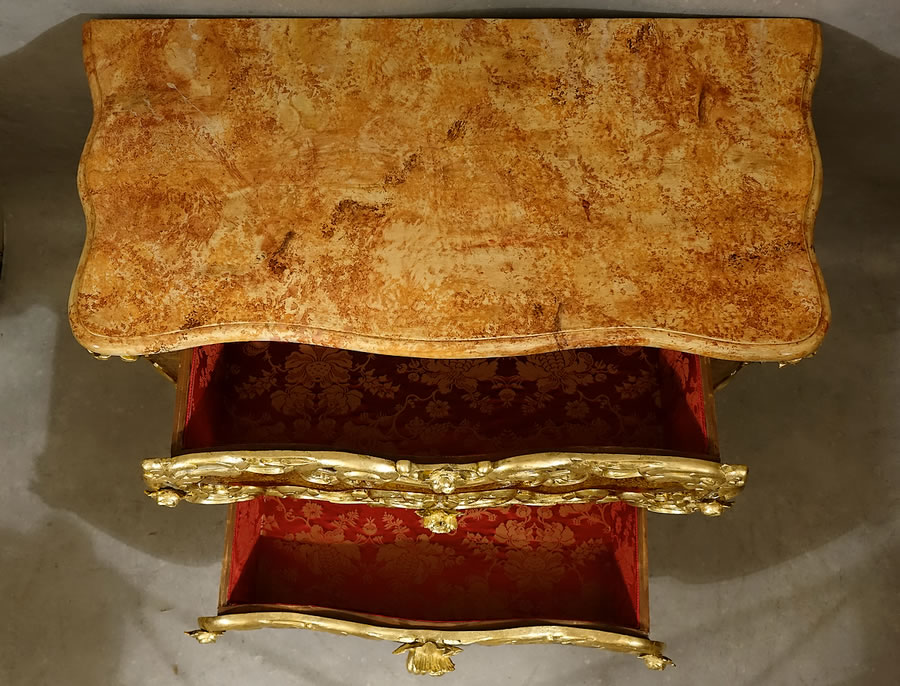
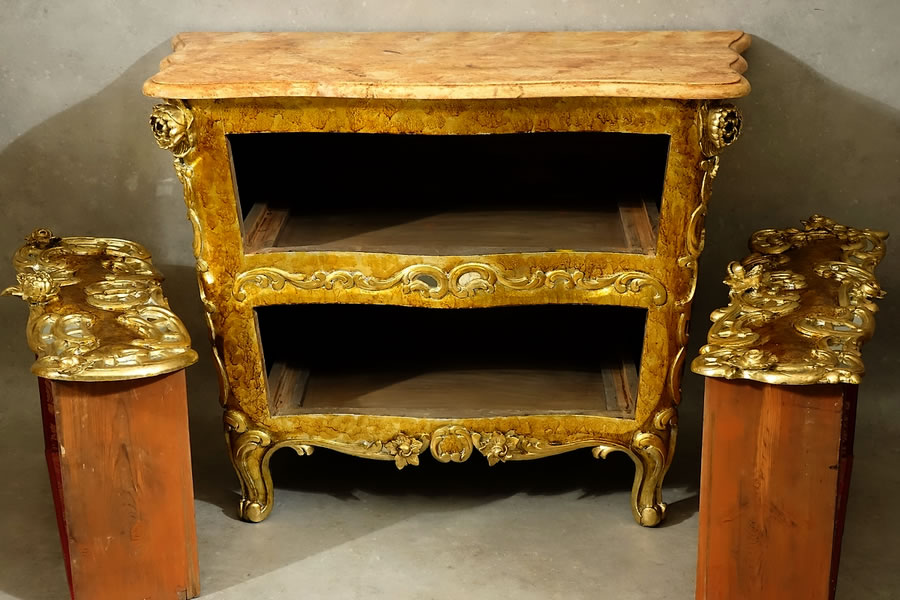
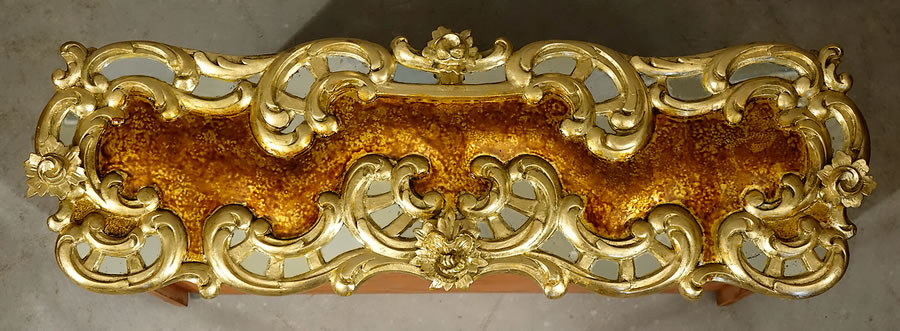
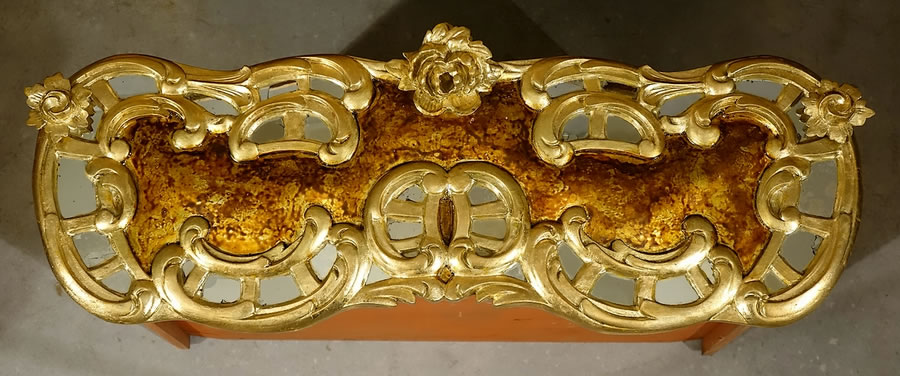
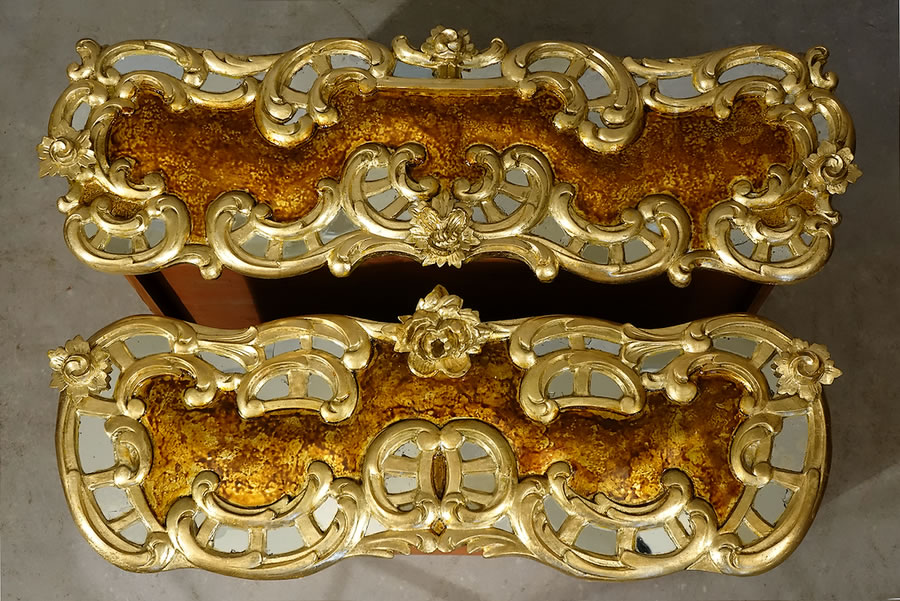
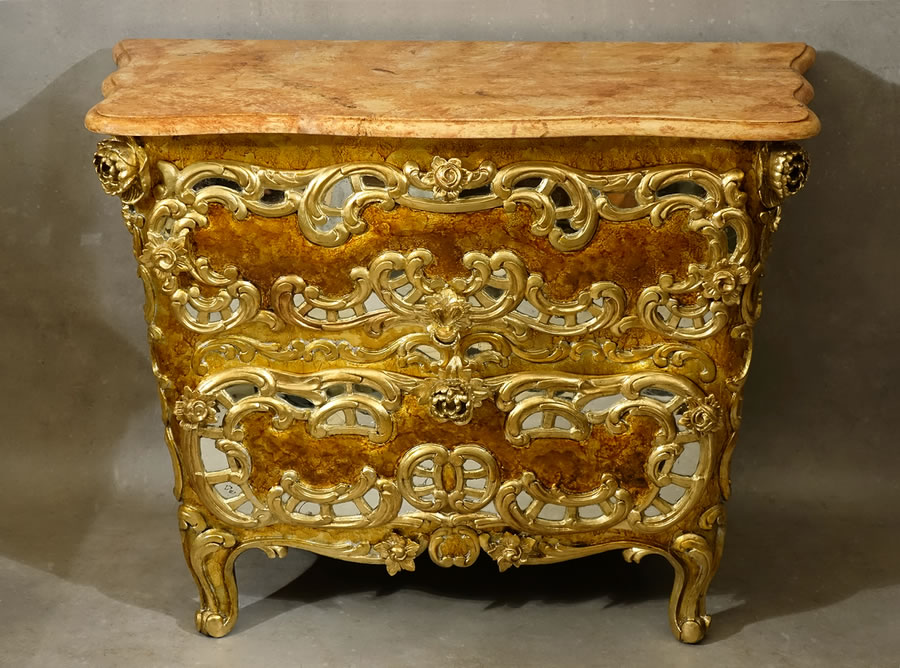
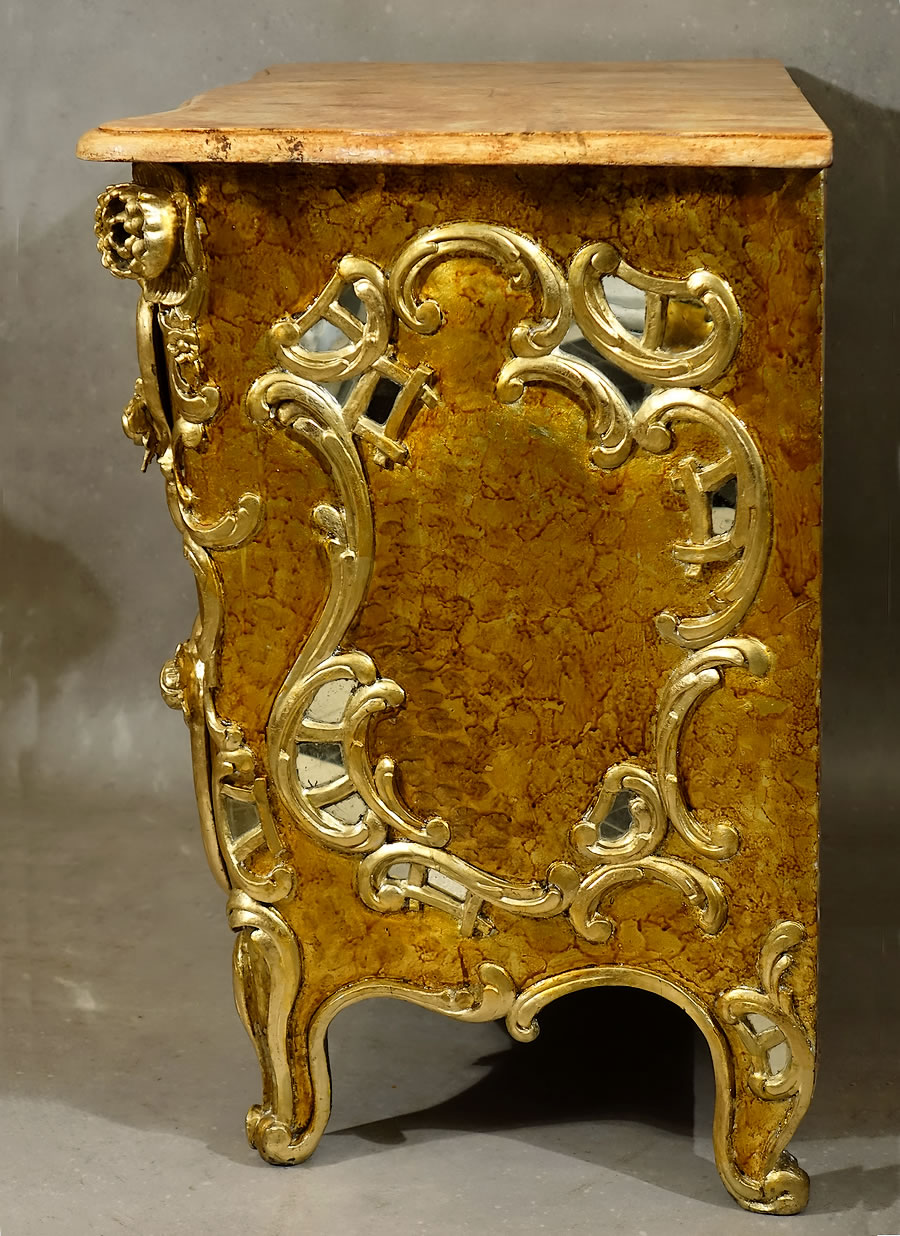
Surmounted by lacquered faux Rouge de Vérone marble tops and opening with two drawers of polylobed outline, the commodes are trapezoidal in form, approaching the so-called “sarcophagus” shape. Built on limewood and fir frames, they are curved on all sides, both in plan and elevation, and exceptionally richly carved with roses and peonies in high relief, the most opulent flowers serving as drawer handles. They are inset with mirrors — exactly eighty-eight on each commode — and articulated by an exuberant carved decoration of C- and S-scrolls, volutes and counter-volutes forming the surrounds of the mirrors, the whole finished in “mecca” varnish and gilding.
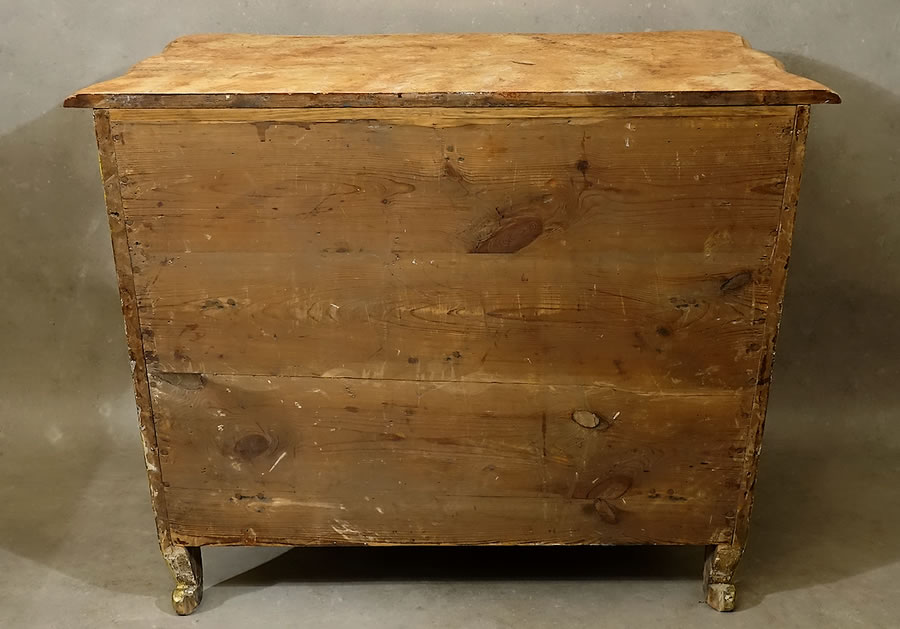
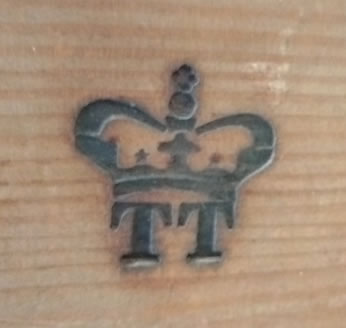
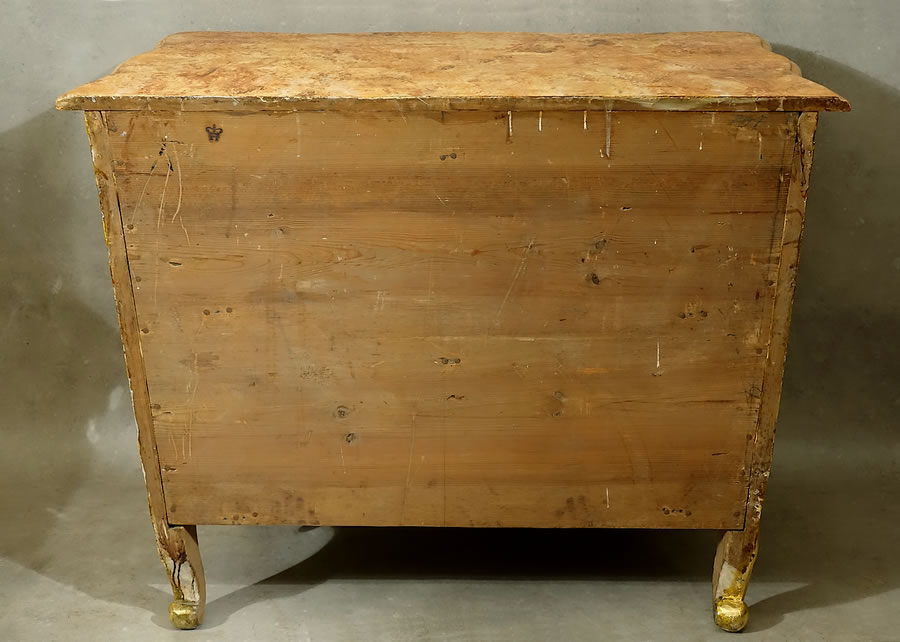
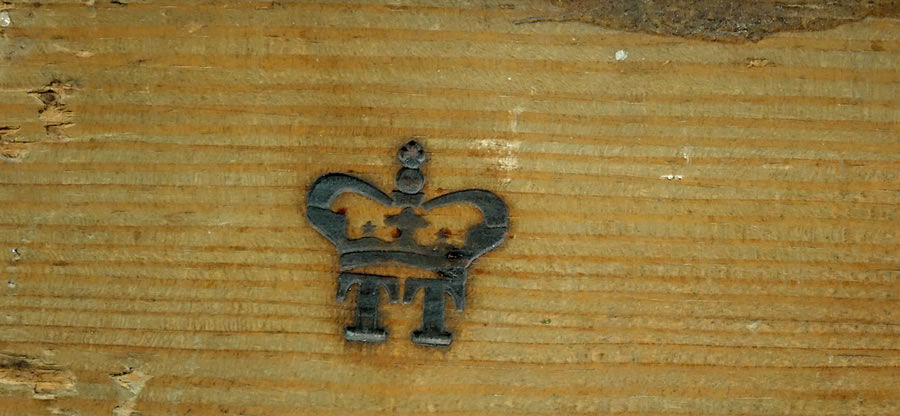
One of the commodes bears on its back the branded inventory mark of the Thurn and Taxis family.

Inventory mark of the della Torre e Tasso family, Italian branch of the Thurn and Taxis house

These pieces were conceived as sculptural compositions and may indeed be regarded as examples of sculptor’s furniture, or Bildhauermöbel: furniture whose creation reflects the combined work of a designer, cabinetmaker, sculptor, gilder and painter.
The model is astonishing, even extraordinary, and may justifiably be regarded as an artistic creation in its own right. It represents the culmination of a decorative formula carried through with remarkable confidence and technical mastery. One need only imagine the challenge facing the craftsman: eighty-eight individual mirrors on each commode, eleven flowers carved in high relief and more than eighty C-scroll movements — without allowing such abundance to overwhelm the composition.
Through this accumulation of mirrors, carved flowers, gilding and mecca varnish, these commodes do more than furnish a room: they fragment and reflect the surrounding space and transform it into an almost theatrical setting.
It is easy to understand why such pieces appealed to distinguished collectors. Beyond their inherent splendour, their provenances are particularly eloquent: important auction houses, internationally renowned antiques dealers, major châteaux and aristocratic families, followed in one case by one of the great figures of Italian cinema — Marcello Mastroianni, whose father was a cabinetmaker and whose uncle was a sculptor.

The two commodes are of virtually identical proportions, and the principal motifs of their ornament are likewise closely related. They therefore form perfect pendants, if not a true pair. Variations occur in details of the carving rather than in its manner or conception. Far from detracting from the ensemble, such differences are characteristic of hand-carved Italian furniture and can be observed in period pairs.
A comparable phenomenon could be seen in a pair of 18th-century Turin transformation corner cupboards formerly in our collection:
Pair of 18th-century Italian corner cupboards
Close comparison of those two pieces revealed subtle variations in the motifs despite their remarkable overall homogeneity and our conviction that they were made by the same hand. We were particularly struck by the confidence of the master carver, who evidently worked with considerable freedom — a freedom suggesting both experience and complete command of his craft.

Reunited today, these two commodes seem to bring together two independent histories — that of a princely European family and that of Italian cinema — within the same dazzling Rococo vision.


Kingdom of the Two Sicilies, Southern Italy.

Late 18th – early 19th century.

Former provenances:
one commode:
Château de Wannegem-Lede collection.
Princely della Torre e Tasso collection.
&
the other:
Collection of the antiques dealer Jean Gismondi, Antibes.
Collection of the actor Marcello Mastroianni.

Sicilian Rococo commode carved, gilded and finished in mecca varnish, front view

Like the Orientalist clock placed upon one of them for this interior photograph, the two commodes carry Rococo decoration almost to the point of spectacle; here, however, movement is created by the interplay of volumes and innumerable curves, gilding and mirrors animating the entire surface of the furniture.

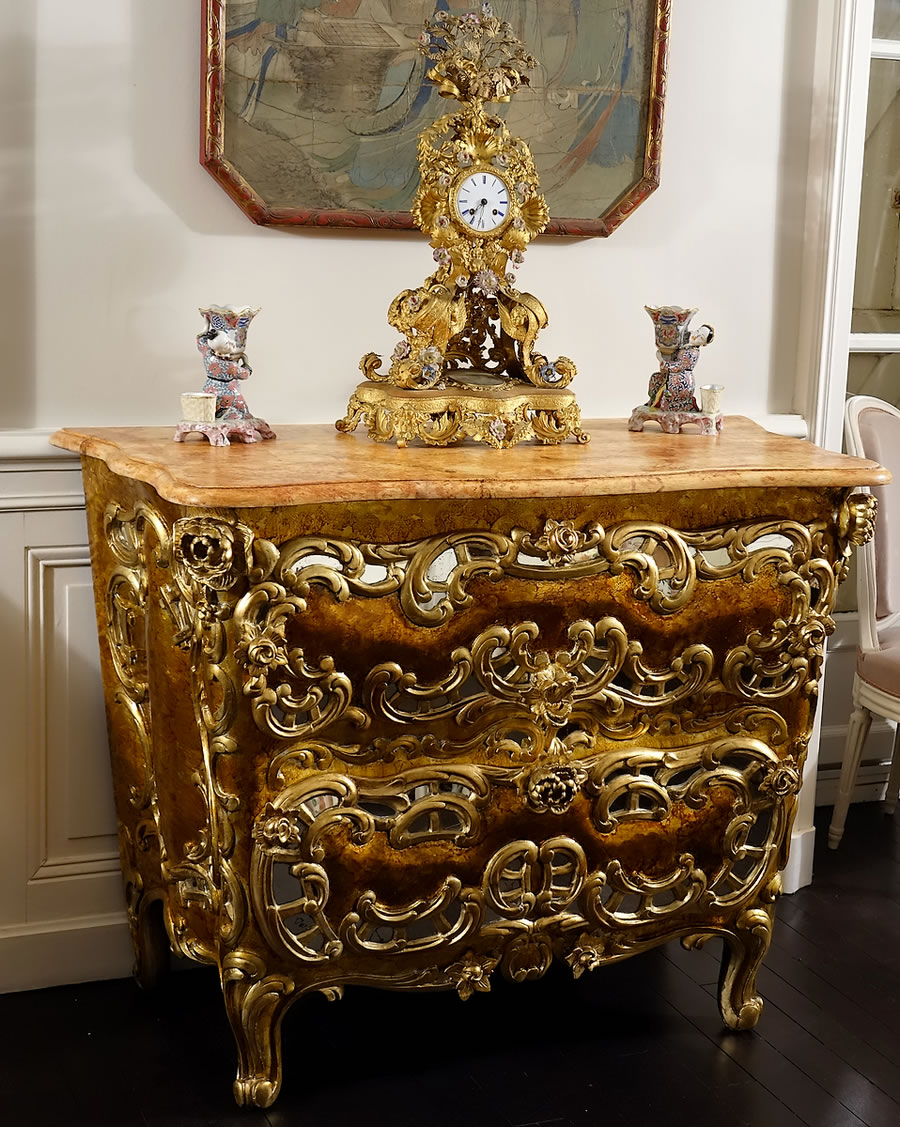
Pair of curved Sicilian Rococo commodes, lacquered, gilded and decorated with mirrors

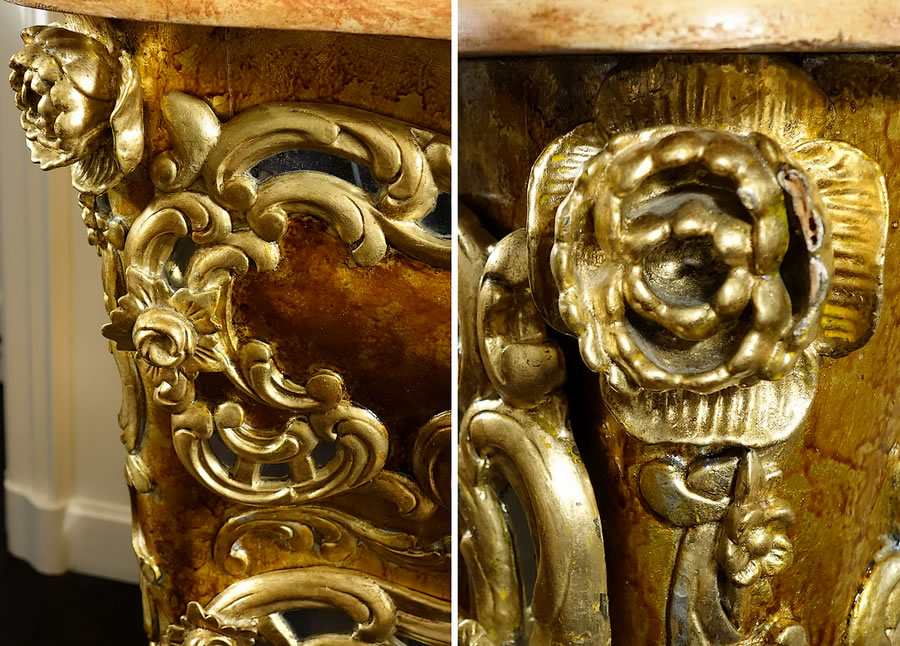
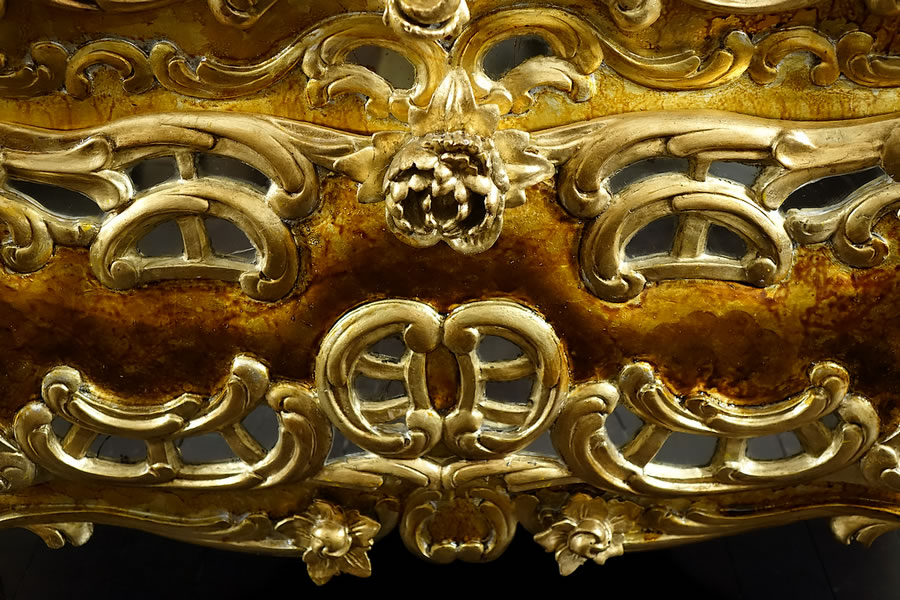
Detail of high-relief carved roses on an Italian Rococo commode

Here one can see the pronounced relief of the fully opened roses and the overlapping C-scrolls,
and below, one of the rose-shaped drawer handles.

Carved peony and rose drawer handles on a Sicilian Rococo commode

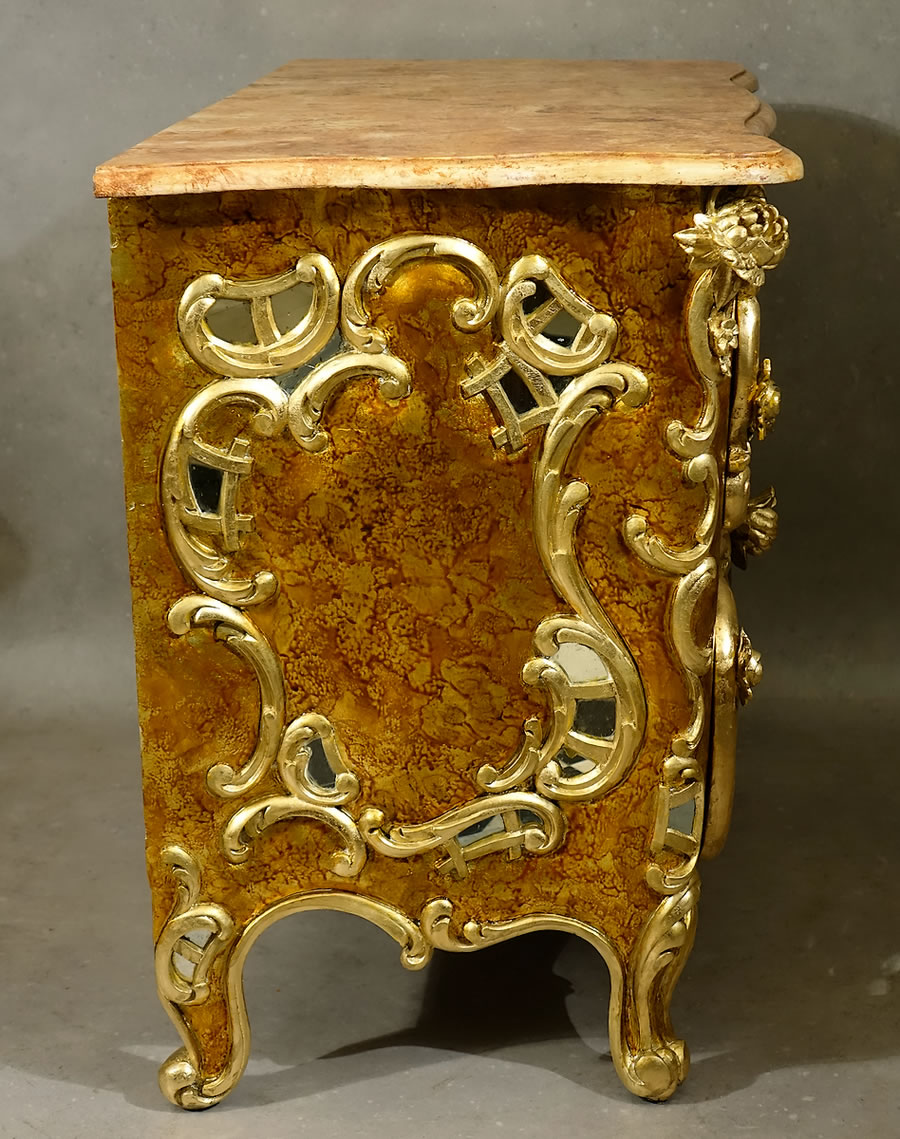
Sicilian Rococo two-drawer commode, detailed view of the curved sides
Here one can see the gently rising curve of the uprights and the deliberately asymmetrical decoration of the sides.
Pair of Italian Rococo commodes finished in mecca varnish, side views


Condition:
Both commodes are in superb condition.
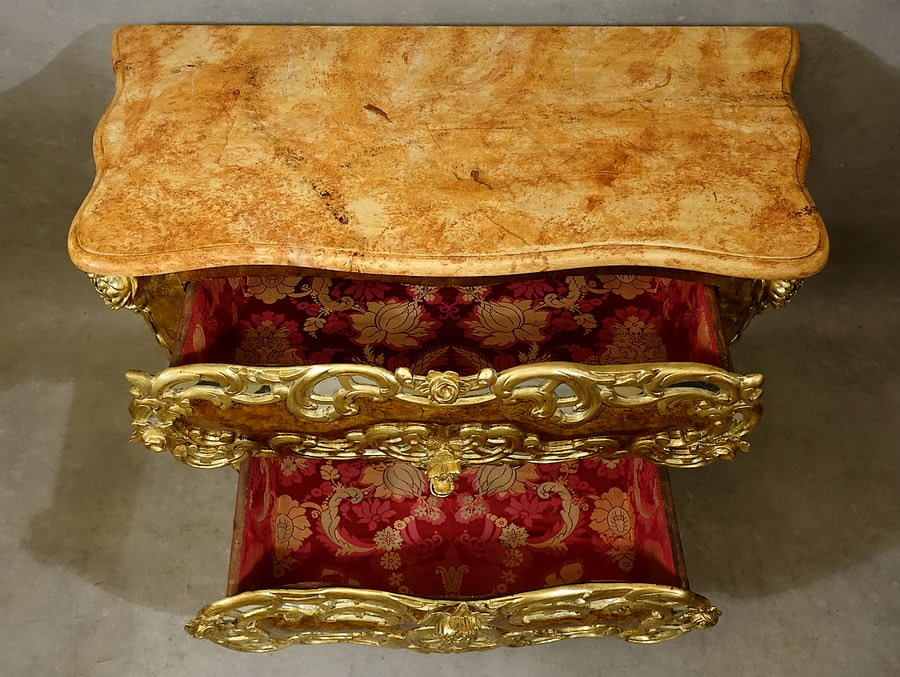
The drawers of the “Mastroianni” commode retain an old red and gold
silk and cotton damask, while those of the “della Torre e Tasso”
commode are lined with a silk and cotton “Meillant Rouge” damask
in similar colours by the celebrated Lyon firm Tassinari & Chatel.


Dimensions:

Height 91 cm × width 108 cm at the front
(122 cm at the back) × depth 58.5 cm.

The della Torre e Tasso Commode

Sicilian Rococo commode from the della Torre e Tasso collection, front view
Pair of Sicilian Rococo commodes, carved, gilded and finished in mecca varnish
Sicilian Baroque Rococo commode from the princely Thurn and Taxis collection
Sicilian Rococo commode with faux Rouge de Verona marble top, Thurn and Taxis provenance
Sicilian Rococo commode of princely della Torre e Tasso provenance

Side of the Rococo commode with mirrors set within richly carved surrounds

Italian Rococo commode, Sicily, Palermo region

Rococo commode with drawers lined in red and gold silk damask

Sicilian Rococo commode with both drawers open and faux-marble top

Sicilian Rococo commode and detail of its two carved drawers

Drawer of a Sicilian Rococo commode decorated with small mirrors

Polylobed drawer of a carved Sicilian Rococo commode

Rococo drawers with carved rose and peony handles, gilding and mecca varnish

Back of a Sicilian Rococo commode bearing the Thurn and Taxis inventory mark

Inventory mark of the della Torre e Tasso or Thurn and Taxis family

The Marcello Mastroianni Commode

Sicilian Rococo commode formerly in the Marcello Mastroianni collection, front view

Carved, gilded and mecca-varnished Sicilian Rococo commode formerly owned by Marcello Mastroianni

Gilded Sicilian Rococo commode with mecca varnish and faux Rouge de Verona marble top

Sicilian Rococo commode in carved, gilded and lacquered wood, Marcello Mastroianni provenance

Sarcophagus-shaped Sicilian Rococo commode, lacquered and gilded, side view

Pair of carved and gilded Sicilian Rococo commodes with drawers open
Pair of Sicilian Rococo commodes with Thurn and Taxis and Marcello Mastroianni provenance
Sicilian Rococo commode with drawers lined in red and gold silk damask
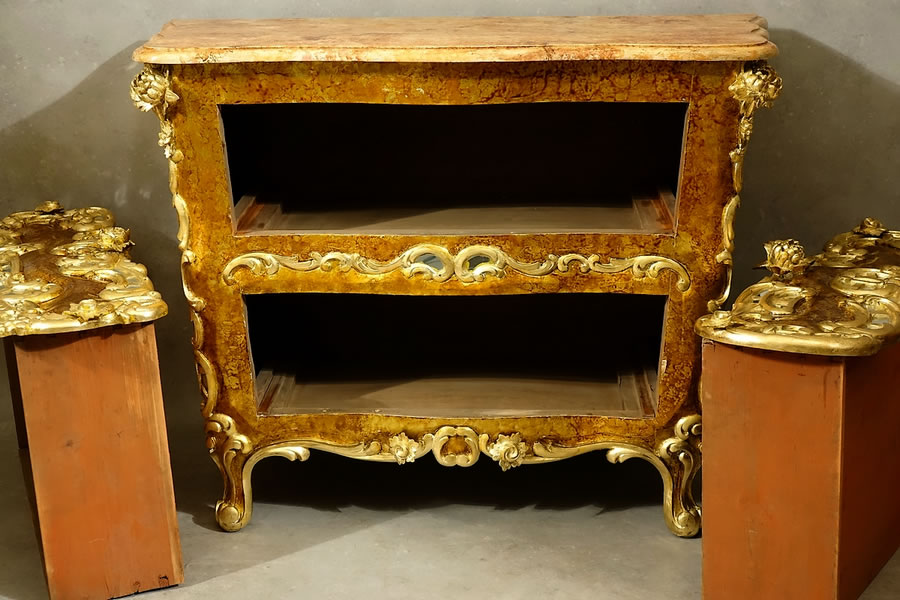
Sicilian Rococo commode with drawers removed, showing the internal construction
Polylobed drawer in carved and gilded wood with mecca varnish and small mirrors
Rococo commode drawer decorated with mirrors and carved high-relief roses and peonies
Sarcophagus-shaped Sicilian Rococo two-drawer commode
Back of the Marcello Mastroianni Sicilian Rococo commode showing the fir-board construction

Attribution Research and Comparative Furniture
Corpus of Rococo Commodes

The research continues on a separate documentary page devoted to comparable commodes, questions of attribution and comparisons with Italian and German Rococo furniture. The documentary page is currently in French.

OPEN DOCUMENTARY PAGE — ENGLISH
© ANTIQUITÉS PHILIPPE GLÉDEL - ALL RIGHTS RESERVED 1998 / 2026